Why Do My Legs Sink When I Swim? The Beginner Balance Fix

Why Do My Legs Sink When I Swim? The Beginner Balance Fix
 Vlad Paturca

On this page
“Your legs sink because your kick is weak.” We hear this in the pool every week, and it’s the most expensive myth in adult swimming. It sends beginners off to kick harder, get more tired, and sink anyway.
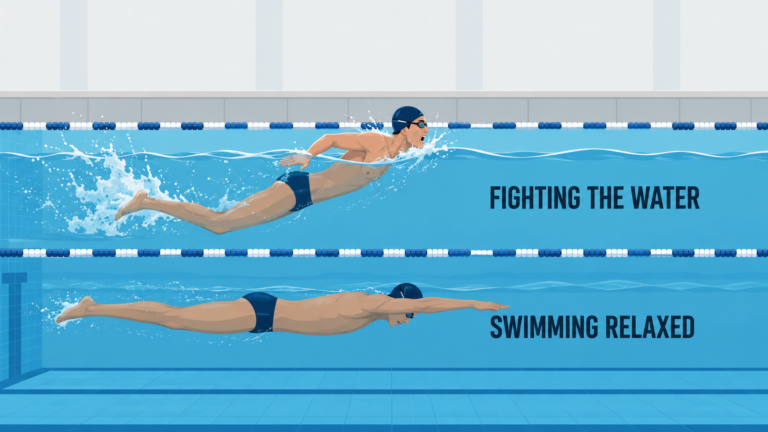
Here’s the real answer. Your legs sink when you swim because of physics and head position, not leg strength. Your lungs are a built-in flotation tank in your chest, while your legs are mostly bone and muscle, which are denser than water. That makes your body a seesaw pivoting around your chest: head up, hips down; head low, hips up. Triathlete magazine’s coaching Q&A breaks down the same principle: sinking hips and feet are a body-position problem before they are a fitness problem. The fix is balance, and you can feel the difference in one session. Here’s how we coach it.
Why Do My Legs Sink When I Swim? The Physics
Two facts about your body explain almost every sinking-leg problem:
- Your chest floats. Air-filled lungs make your upper body naturally buoyant. Hold a full breath and your chest bobs like a cork.
- Your legs don’t. Muscle and bone are denser than water. The leaner and more muscular your legs, the truer this is, which is why muscular swimmers (and most men) fight sinking legs more than others.
Put those together and your body becomes a seesaw with the pivot at your chest. Anything that lifts the head end drops the leg end. Lifting your eyes to see the wall, craning up to breathe, holding a chest full of air: each one presses the seesaw the wrong way.
That’s also why “kick harder” fails. A harder kick fights the seesaw instead of rebalancing it. You’re spending energy to hide a position problem, and it comes apart the moment you tire.
The Beginner Balance Fix: Heavy Chest, Quiet Head
One cue does most of the work: press the chest slightly down and forward, and keep the head quiet.
You’re not forcing yourself underwater and you’re not tensing your abs. You’re leaning on the buoy (your lungs) so the seesaw tips your hips up. Swimmers feel it as a “heavy chest”; from the deck it looks like a longer, flatter body line.
Your push-off checklist:
- Eyes down at the pool floor, not the wall
- Long neck
- Ribs soft, no lower-back arch
Coach’s tip: the 30-second self-test. Push off, arms out, face in, and do nothing for three seconds. No kick, no stroke. If your legs drop immediately, your head is too high or your chest isn’t pressing enough. Retest after every fix; it’s your progress meter.
How to Not Sink When Swimming: 3 Triggers You Can Fix Today
| What you feel | What’s actually happening | The fix |
|---|---|---|
| “I need to see where I’m going” | Lifted head tips the seesaw, hips drop, drag doubles | Eyes down, trust the lane line on the pool floor |
| Tight chest, gasping at each breath | Held breath keeps the chest over-buoyant and tense | Gentle bubbles the whole time your face is in the water |
| Shoulders pop up, legs drag | Arms pressing down on the water instead of back | Reach long, start every pull by sending water backward |
Notice what’s not in the table: kick harder, buy gear, do core work at the gym. Those all have their place later. None of them fixes a seesaw.

Stop Sinking Legs in Freestyle with 2 Balance Drills
These two drills fix sinking legs in freestyle faster than any kick set we know.
1) Superman Glide
Push off gently, both arms extended, face in, eyes down. Hold 5 to 10 seconds and count. Legs drifting down? Press the chest a touch more and lengthen the neck. Resist the urge to kick your way out of it; the drill is the diagnosis.
2) Side Balance (“Skate”)
One arm extended, the other resting on your side, body rotated about 45 degrees, cheek resting in the water. Keep the head still and the hips near the surface with only a small, quiet flutter. When this feels controlled on both sides, whole-stroke freestyle suddenly feels like it has room in it.
Breathing Without Dropping Your Hips
Breathing is where balance goes to die. The cue we use: one goggle in, one goggle out.
- Exhale gently and continuously underwater. Never hold.
- Turn with your body’s rotation; don’t lift your face forward.
- Sip the air and get the face back in early.
If both goggles clear the water, your head has risen and your hips have already paid for it. Breathing tension is its own skill to build; our guide to freestyle breathing made simple takes it step by step.

Kick, Pull Buoys and Wetsuits: Help or Crutch?
Three honest verdicts, because gear questions come up in every lesson:
- Your kick should be small and quiet. From the hips, soft knees, loose ankles. A big splashy kick is a balance problem wearing a disguise. The kick’s job at this stage is stability.
- A pull buoy is a diagnosis tool. Swim with one and your hips float perfectly? Congratulations, you’ve confirmed the problem is balance. The buoy hasn’t fixed anything; it’s doing the balancing for you. Use it to feel the correct position, then earn that position without it.
- Wetsuits and buoyancy shorts lift your legs artificially. Great for open water and triathlon day, and honest about nothing. If you only ever swim buoyant, the seesaw is still broken underneath.
Your 10-Minute Pool Plan (2-3x per Week)
| Set | What | Focus |
|---|---|---|
| 2x | Push off + 10 second Superman Glide | Count the seconds before legs drift |
| 4x 15 m | Side Balance, switch sides each length | Head still, hips at the surface |
| 4x 25 m | Easy freestyle | “Heavy chest, quiet head”, breathe low |
| 1x 25 m | Normal freestyle | Same cues, no extra effort |
Fair warning from the deck: the first sessions feel different, not instantly easier. Your body is recalibrating what “level” feels like. Give it three swims before you judge the results, and rate yourself on the self-test, not on speed.
Practising in Amsterdam: Where and How
For drill work you want a lane where slow, deliberate swimming is welcome. Sloterparkbad has a 50 metre option for uninterrupted lengths, though a teaching pool suits true beginners better. In summer, official open-water spots are tempting; check Zwemwater.nl for designated locations and water quality first (the Dutch monitoring season runs May 1 to October 1), and treat open water as a place to enjoy balance you’ve already built in the pool.
Balance is also the fastest thing to fix with eyes on you. At Win and Swim we teach small-group beginner swimming lessons in Amsterdam-Noord, and body position is lesson one, because every other skill sits on top of it. I’ve watched adults fight sinking legs for years, then hold a clean Superman Glide within one coached session, simply because someone finally moved their head two centimetres. If you’re in the area, our pool is at the Friendship Sport Center in Amsterdam-Noord.
Sinking legs also load your lower back through all that arching and craning; if that sounds familiar, read our take on swimming with lower back pain.

FAQ
Why do my legs sink when I swim? Legs sink because air-filled lungs make the chest buoyant while legs are dense muscle and bone, turning the body into a seesaw that pivots at the chest. Lifting the head, holding the breath, or pressing the arms down tips the seesaw and drops the hips. It is a balance problem, not a leg-strength problem.
Do muscular people sink more easily in water? Yes. Muscle is denser than water while body fat floats, so lean, muscular swimmers carry less natural buoyancy, especially in the legs. They need better balance technique sooner, but the same fixes work: eyes down, steady exhale, chest pressed slightly forward.
Does a pull buoy fix sinking legs? No. A pull buoy holds the hips up artificially, which makes it a useful tool for feeling the correct body position, but the legs sink again the moment it’s removed. Use it briefly to learn the sensation, then rebuild the position with balance drills like the Superman Glide.
How do I stop sinking when swimming freestyle? Keep the eyes down, exhale continuously underwater, press the chest slightly down and forward, and breathe by rotating with one goggle still in the water. Short balance drills such as the Superman Glide and Side Balance retrain the position in 2 to 3 short sessions per week.
Is a weak kick the reason my legs sink? Rarely. A weak kick loses you a little propulsion, but sinking legs come from head position and chest buoyancy. Kicking harder hides the problem and burns energy; fixing balance removes it.
The water will hold your legs up all day; your job is to stop arguing with it.
Written by
Vlad Paturca
KNZB-certified swim coach, former Romanian national and international freestyle medalist, and founder of Win and Swim Amsterdam. Passionate about adult learners and evidence-based technique. With a bachelor degree in swimming and a first aid course, swimming is my element.
More about Win and Swim →