
Is Swimming Good for Lower Back Pain? Here’s the Real Answer

Is Swimming Good for Lower Back Pain? Here’s the Real Answer
 Vlad Paturca
On this page
If you’ve been told to “just go swimming” for your back, you’ve been given half an answer. We coach adults with cranky backs every week in Amsterdam-Noord, and the truth is more useful than the slogan.
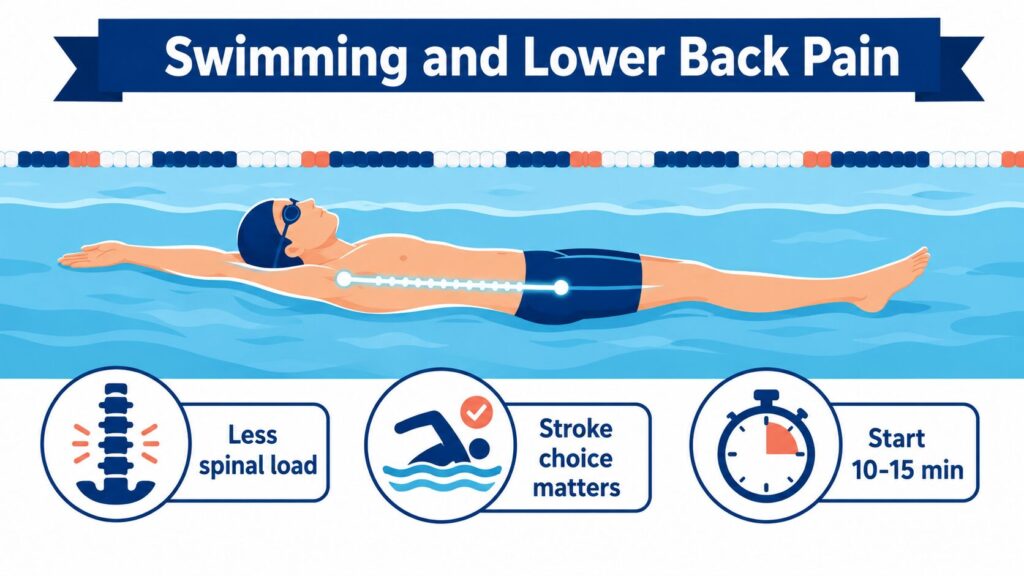
Here’s the honest answer up front. Swimming can help lower back pain: the NHS lists swimming among the activities that may ease back pain, and staying active beats resting for most non-specific back pain. But the research is less tidy than the slogan. A 2024 scoping review in Musculoskeletal Science and Practice looked at 44 studies and found no clear overall pattern between swimming and low back pain. What decides your result is not “swimming” as a concept. It’s the stroke you choose, the technique you swim it with, and the dose you start at. This guide covers all three.
Is Swimming Good for Lower Back Pain? The Honest Answer
Three things are solidly true:
- Movement beats rest. For most non-specific lower back pain, staying gently active leads to better outcomes than lying low. That’s standard NHS guidance, and it’s what we see on the pool deck.
- Water lowers the load. Immersion supports roughly 90% of your body weight, so your spine works in a low-compression environment that running and gym work can’t offer.
- The evidence for swimming specifically is mixed. That 2024 review of 44 studies found most research was done on competitive swimmers, with only one randomised controlled trial in the lot. Nobody can honestly promise you that swimming fixes backs.
There’s also encouraging newer evidence on the lived experience side. A 2025 qualitative study followed 14 adults with chronic low back pain (some had lived with it for decades) and found swimming became a valuable self-management tool. One participant put it in words we hear constantly at the pool: “It just felt like that kind of support of being held in the water that really seemed to make it a lot easier.”
So the real question isn’t whether swimming is good for lower back pain in general. It’s whether your stroke, your technique and your dose fit your back.
Why Swimming for Back Pain Can Work Better Than Land Exercise
On land, every step loads the spine with impact. In the water, buoyancy carries most of your weight, which means you can move, rotate and strengthen without the jarring.
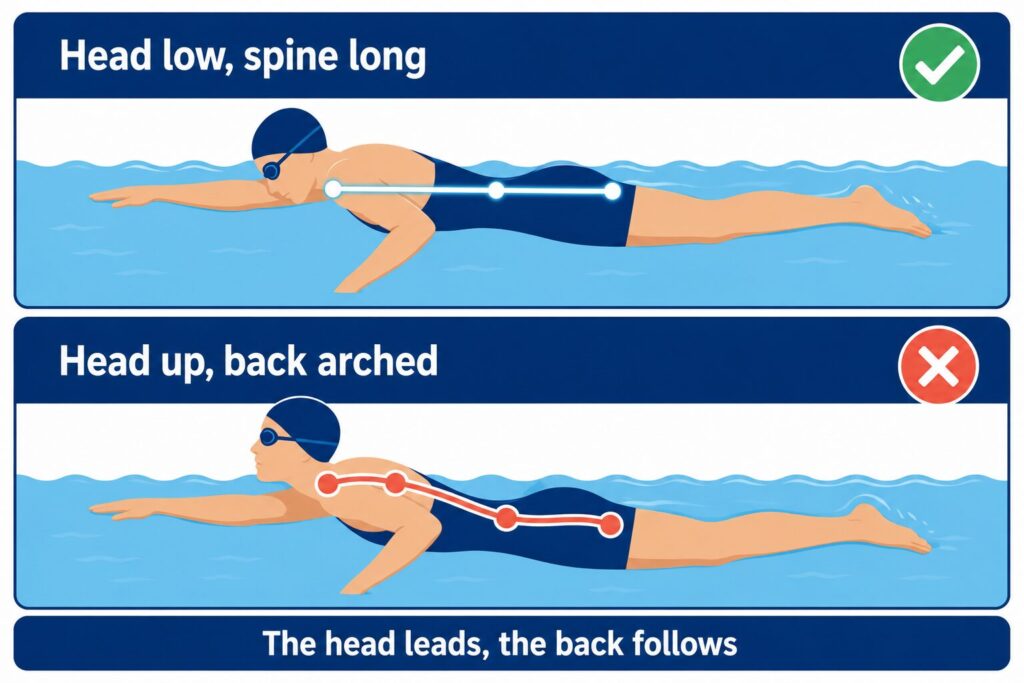
The pool does something else land training doesn’t: it exposes bad habits instantly. Lift your head, hold your breath, or rush the stroke, and your body line collapses, your hips sink, and your lower back arches to compensate. That feedback loop is why we treat breathing as the first back-pain skill: exhale steadily underwater, keep the head low, and turn with the shoulders to breathe instead of lifting the head. If breathing is your sticking point, our guide to freestyle breathing made simple walks through it step by step.
Best Swimming Stroke for Lower Back Pain, Stroke by Stroke
There is no single best swimming stroke for lower back pain, because backs and their problems vary. But strokes are not equal either. Spine-health notes that butterfly and breaststroke force the lower spine to arch backward, which loads the facet joints at the back of the spinal column. Here’s how we rank the options with a sore lower back, and what we fix first:
| Stroke | Verdict with lower back pain | Why | Coach’s fix |
|---|---|---|---|
| Backstroke | Usually the friendliest start | Spine stays long and supported, face clear of the water, no head-lift | Keep hips near the surface; gentle steady kick |
| Front crawl | Good, if breathing is calm | Flat body line, rotation spreads the work | Breathe by rotating with the shoulders; never lift the head forward |
| Breaststroke | Caution | Head-high style arches and stiffens the lower back on every cycle | Lower the head between breaths, shorten the glide, or swap strokes |
| Butterfly | Skip it for now | Repeated forceful lumbar extension | Return to it when pain-free; it earns nothing here |
The pattern behind the table: a stroke helps when your trunk stays long, quiet and relaxed, and hurts when it makes you brace, twist or arch. If a stroke makes you brace, shorten the distance, slow it down, or change the stroke.
How to Swim with Lower Back Pain Without Making It Worse
The mistake we see most isn’t the wrong stroke. It’s the right stroke at ten times the sensible dose. Ten to fifteen calm minutes with rest is more useful than one heroic session that wrecks you for two days.
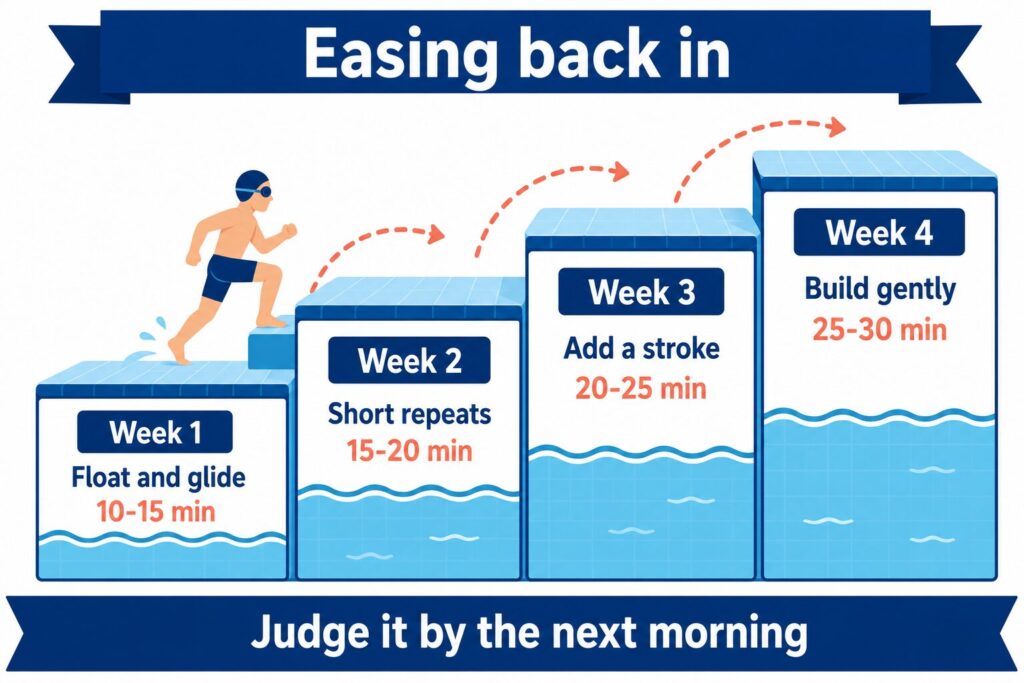
Our easing-in plan for adults coming back with a sore lower back:
| Week | Session | What it looks like |
|---|---|---|
| 1 | 10-15 min, 1-2x | Walk in chest-deep water, float, glide, easy backstroke legs. Stop fresh |
| 2 | 15-20 min, 2x | Short 25 m repeats with full rest between. One stroke, easy pace |
| 3 | 20-25 min, 2x | Add a second stroke if pain allows. Still resting between lengths |
| 4 | 25-30 min, 2-3x | Longer repeats only if the day after feels fine. Technique first, always |
Rules that protect you along the way:
- Warm up in the water before any proper lengths: walking, floating, easy gliding.
- Keep the head quiet. In front crawl, turn with the body for air. A lifted head is a lifted back.
- Swim short repeats. 25 metre lengths with rest keep your form honest.
- Stop while your technique is still good. Fatigue degrades form, and degraded form is how symptoms sneak back in.
- Judge the session by the next morning, not by how tough it felt in the pool.
If your legs sink the moment you stop kicking hard, that’s a balance problem that loads the lower back too; our sinking legs fix covers it.
Can Swimming Make Back Pain Worse? Yes, and Here’s When
Low impact does not mean zero risk. Swimming makes back pain worse in predictable situations: too much volume too soon, a head-high breaststroke, a stiff neck and held breath, or forcing intensity before technique is ready.
And some symptoms are not technique problems. Stop swimming and seek urgent medical care if you have severe or steadily worsening pain, pain or weakness in both legs, numbness around the genitals or buttocks, or changes in bladder or bowel control. Those are the red flags in NHS back pain guidance, and no coach should be your first call for them.
What We Watch First with Adults in the Pool
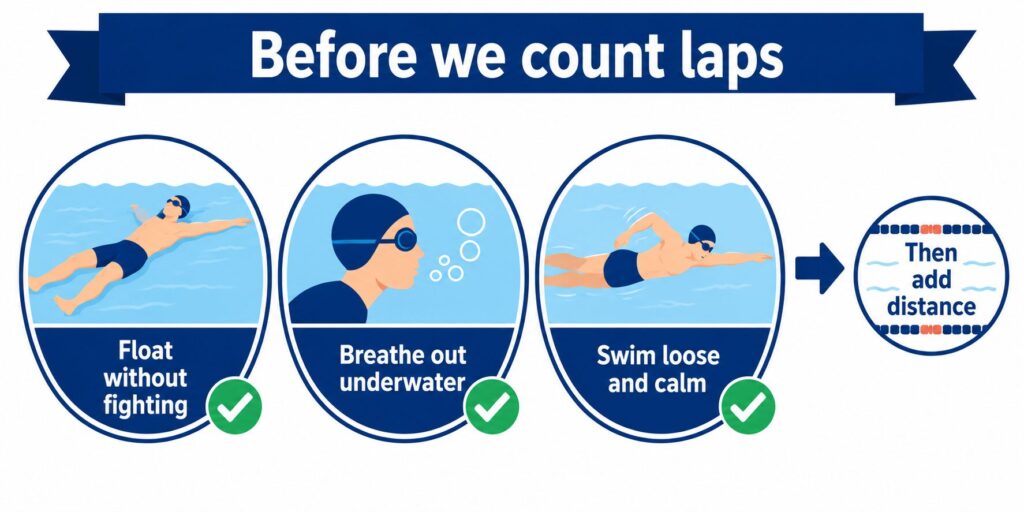
At Win and Swim we coach adults only, in heated 25 metre pools in Amsterdam-Noord, in English. When someone arrives with a history of back pain, mileage is the last thing on our list. We watch three things: can you float without fighting the water, can you breathe out steadily with your face in, and can you move through a length with loose shoulders and a calm spine.
I’ve coached adults who spent years avoiding the pool because one bad session convinced them swimming “didn’t work” for their back. Almost every time, the problem was a head-high breaststroke swum flat-out on day one. Rebuilt from floating and breathing upward, the same swimmers were doing comfortable front crawl repeats within a couple of months.
That rebuild is exactly what structured beginner swimming lessons for adults are for: patience, progression and clear technical cues instead of guesswork. And if you want the bigger picture of what regular swimming does for your body beyond the back, we’ve covered the health benefits of swimming separately.
FAQ
Is swimming good for lower back pain? Swimming can help lower back pain because it lets many adults stay active with far less spinal load, and NHS guidance lists swimming among activities that may ease back pain. Results depend on stroke choice, technique and starting dose, and a 2024 review of 44 studies found no guaranteed effect.
What is the best swimming stroke for lower back pain? Backstroke is usually the friendliest starting stroke for lower back pain because the spine stays long and the face stays clear of the water. Relaxed front crawl with calm rotational breathing is a good second. The best stroke is any stroke you can swim without bracing, twisting or arching.
Can swimming make back pain worse? Yes. Too much volume too soon, a head-high breaststroke, a stiff neck with held breath, or forcing intensity can all aggravate lower back pain. Low impact reduces risk; it does not remove it.
Is breaststroke bad for lower back pain? Breaststroke becomes a problem when the head rides high and the lower back arches and stiffens on every stroke cycle, loading the facet joints. A lower head position, shorter glides and shorter sets reduce the strain, or switch to backstroke while symptoms settle.
How often should I swim with lower back pain? Start with one or two sessions of 10 to 15 calm minutes in the first week and build toward two or three sessions of 25 to 30 minutes over about a month. Judge each session by how the back feels the next morning, and progress only when a step feels easy.
When should I stop swimming and get checked? Stop and seek urgent medical care for severe or worsening pain, pain or weakness in both legs, numbness around the genitals or buttocks, or changes in bladder or bowel control. These red flags need a doctor, never more laps.
Your back doesn’t need a hero session; it needs a quiet, well-swum length, and then another one next week.
Written by
Vlad Paturca
KNZB-certified swim coach, former Romanian national and international freestyle medalist, and founder of Win and Swim Amsterdam. Passionate about adult learners and evidence-based technique. With a bachelor degree in swimming and a first aid course, swimming is my element.
More about Win and Swim →