How to Swim Breaststroke: A Coach’s Guide for Adults
How to swim breaststroke the right way: a coach explains the pull, breathing, timing and a knee-friendly kick, plus the drills that give you a real glide.

How to Swim Breaststroke: A Coach’s Guide for Adults
 Vlad Paturca

On this page
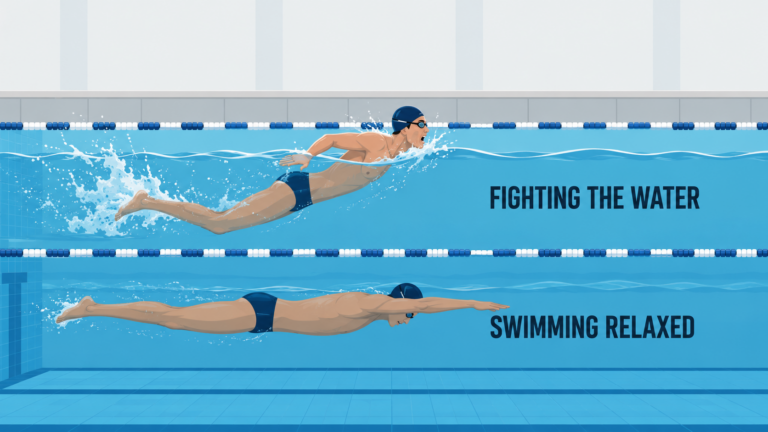
Breaststroke looks like the easy stroke. Your head can stay up, you can breathe whenever you want, and in any Dutch pool on a Sunday morning half the lanes are doing it. Then you try to swim it properly and it falls apart. Your arms and legs work against each other, you stop dead after every stroke, and after a few lengths your knees or neck start to complain.
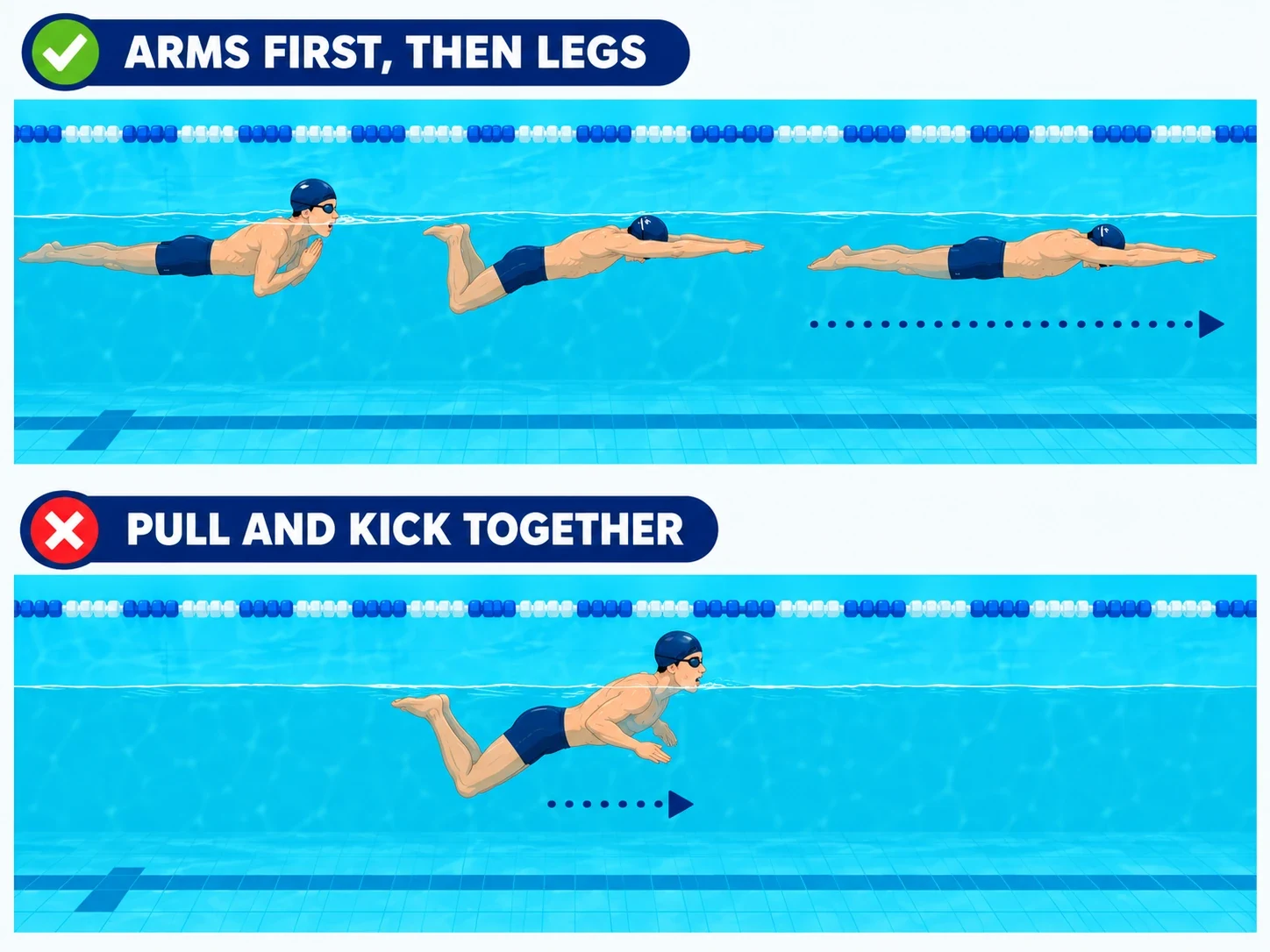
Learning how to swim breaststroke well is mostly about order. You pull with your arms, breathe as they finish, kick with your legs, then glide with your body stretched long before the next stroke. Pull, breathe, kick, glide. The World Aquatics racing rules say the same thing more dryly: every cycle is one arm stroke followed by one leg kick, in that order. Nearly every breaststroke problem I see in adults comes from those two things happening at once.
Quick answer: To swim breaststroke, start in a long glide with your face in the water. Sweep your hands out and round to your chest, letting your shoulders and head rise to breathe as they come in. Then shoot your hands forward, draw your heels up, turn your feet out and kick them round and back together. Hold the stretched-out glide for a second before the next stroke.
I’ve written this for adults who can already swim a bit, and especially for anyone who learned the Dutch head-up version as a kid and would like to swim further without a stiff neck.
How to Swim Breaststroke: One Cycle, Four Moves
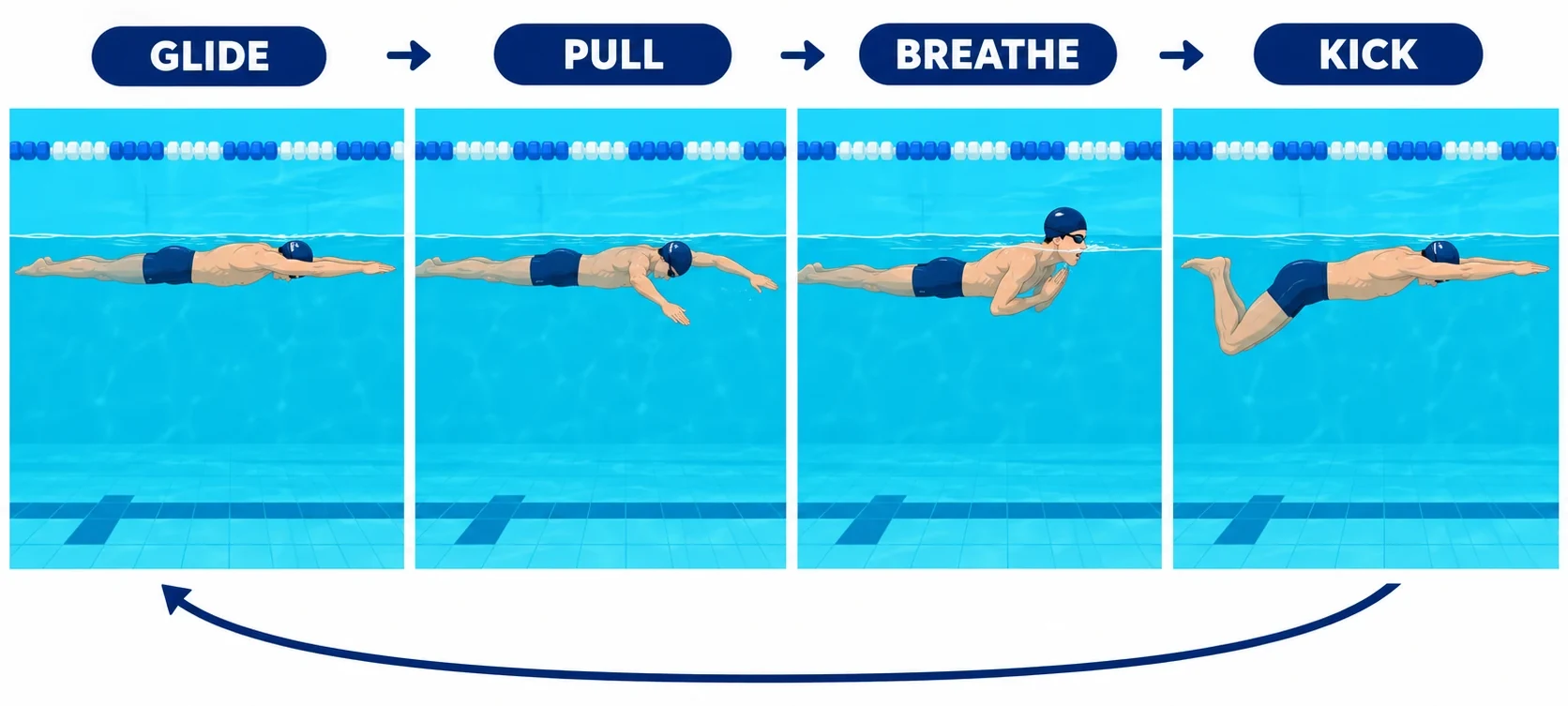
Every breaststroke cycle has the same four parts, and you do them one after another, never on top of each other.
- Glide. Arms straight in front, hands close together, face in the water looking at the bottom, legs straight behind you. This is the fastest you’ll move in the whole cycle, so don’t rush out of it.
- Pull. Turn your palms slightly outward and sweep your hands apart until they’re a little wider than your shoulders. Bend your elbows, keep them high, and sweep your hands in and together under your chest. It’s a smaller movement than most people think.
- Breathe. As your hands sweep in, your chest and shoulders rise on their own. Your mouth clears the water and you breathe in. You don’t need to lift your chin at all.
- Kick. While your hands shoot forward, draw your heels up toward your seat, turn your feet out, and drive your legs round and back until they snap together. That kick carries you straight back into the glide.
Breaststroke breaks the rules freestyle teaches you. In freestyle your arms do most of the work and a big kick wastes energy. In breaststroke the kick is where much of your speed comes from, and the pause is part of the stroke. A swimmer who glides for a full second often travels further per stroke than one who never stops moving.
Breaststroke Technique, Part by Part
Once the order is right, good breaststroke technique comes down to four details: how flat you lie, how small you pull, when you breathe, and how long you wait.
Body position: flat in the glide
In the glide you want one long line from fingertips to toes, hips close to the surface. Breaststroke is a stroke that rises and falls: your shoulders come up for the breath, then your whole body goes back down and forward into the glide. The mistake is staying up. If your head is out of the water at the moment you kick, your hips sink and your kick pushes you upward instead of forward.
If your legs drag even in the glide, fix that before anything else. The balance drills in our sinking legs guide work for breaststroke too.
The arm pull: smaller than you think
Almost every adult pulls too far. Hands sweep out, then keep going all the way back to the hips, like rowing a boat. It feels strong, but your hands end up behind you at the exact moment you need them in front, and your arms tire long before your legs.
Keep the whole pull in front of your shoulders. Picture scooping the water toward your chin, not pushing it past your stomach. Elbows stay higher than your hands during the sweep. Then the recovery: hands come together under your chin and shoot forward, just under or on the surface, like pushing a pair of praying hands through a letterbox. The recovery should be the quickest part of the arm cycle.
Breathing: once every stroke
Yes, you breathe on every breaststroke cycle, as your hands sweep in and your chest rises. What makes it work is breathing out underwater during the kick and glide, a steady stream of bubbles through your nose and mouth. Then the breath in only takes a moment, because your lungs are already empty.
If you hold your breath with your face in the water, you’ll come up needing to breathe out and in during one short window, and you’ll be gasping by the far wall. It’s the same exhale habit that fixes freestyle, and we cover it in more depth in freestyle breathing made simple.
Timing: pull, breathe, kick, glide
Timing is where breaststroke technique usually breaks. The classic fault is kicking while the arms are still pulling, so the two movements cancel each other out and you stall. It feels like working hard and going nowhere.
Say it in your head as you swim: arms, then legs, then wait. Your legs should start to kick as your hands start moving forward, so your arms are already stretched out by the time the kick finishes. Then hold the glide. How long depends on the pace. On easy lengths, count “one” before you pull again. When you swim faster the glide gets shorter, but it never goes away completely.
The Breaststroke Kick: Whip Kick vs Frog Kick
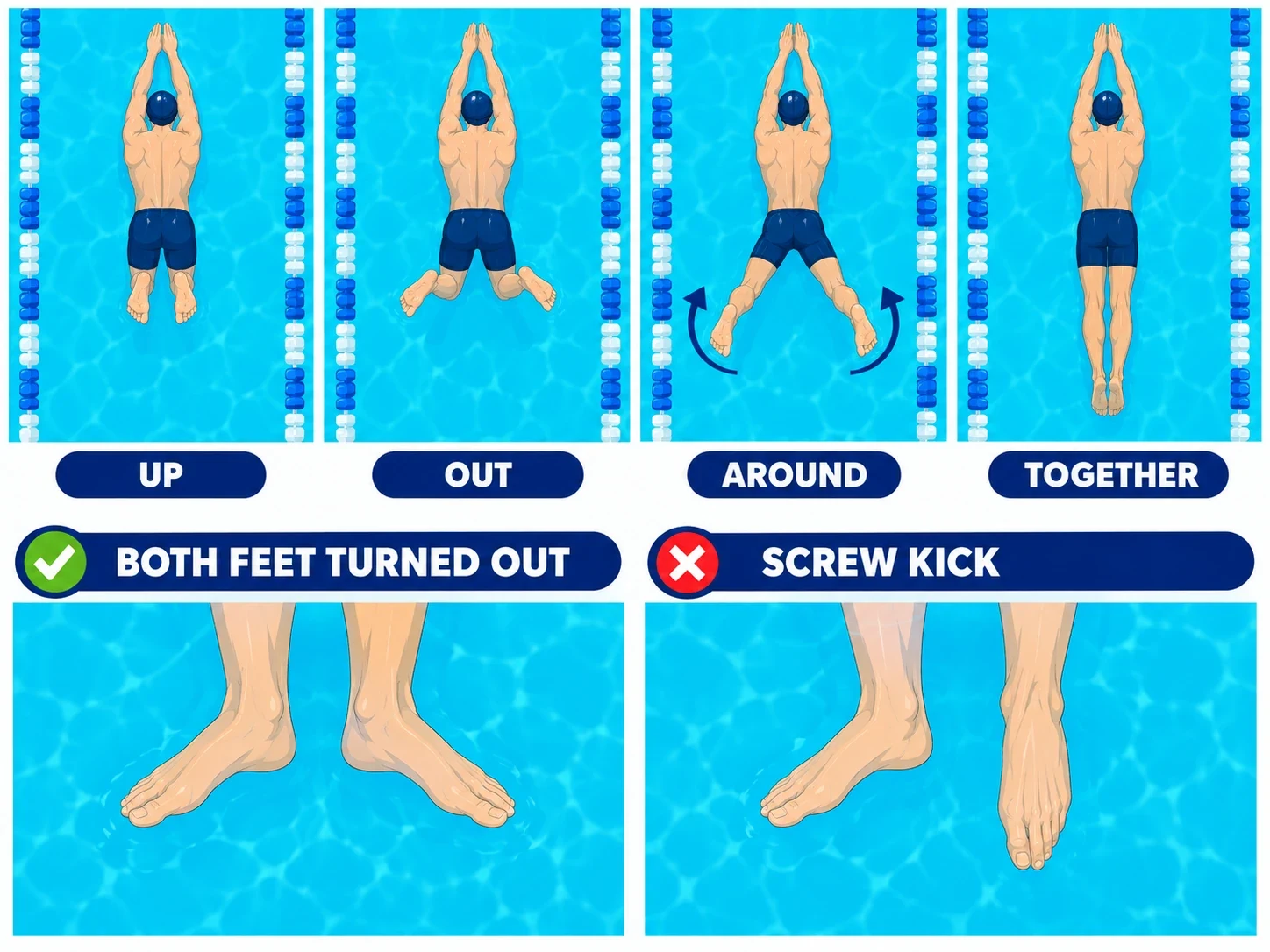
The breaststroke kick is the part adults find hardest, because the feet do something they never do on land. Swimming teachers use four words for it: up, out, around, together.
- Up. Draw your heels up toward your seat, knees staying roughly in line with your hips. Your thighs shouldn’t drop down under your body.
- Out. Flex your feet and turn your toes out to the sides, so the soles and insides of your feet face backward.
- Around. Push back and round in a quick half circle, driving the water behind you with the insides of your feet.
- Together. Finish with your legs straight, feet together and toes pointed, then hold that line through the glide.
Kicking with pointed toes is the most common reason a breaststroke kick goes nowhere. A pointed foot slices through the water. A flexed foot, turned out, grips it. You’ll see two kick styles in any pool, and adults ask me all the time which one to use.
| Frog kick | Whip kick | |
|---|---|---|
| Knee width | Wide, well outside the hips | Close, about hip-width |
| How it feels | Big, slow circle | Quick, narrow snap |
| Speed | Slower | Faster |
| Needs | Little hip mobility | Good hip and knee mobility |
| Good for | Relaxed lengths, treading water, beginners | Faster laps, racing |
My answer for most adults is somewhere in the middle: knees a bit narrower than a frog kick, a bit wider than a racing whip, with the feet travelling outside the knees. That’s where the kick feels powerful without twisting the knee (the research is in the knee section further down). If you already use a frog kick for treading water, the movement is related, and our guide to treading water for adults shows how the two connect.
The screw kick
Watch adults swim breaststroke for a while and you’ll spot the screw kick: one foot turns out properly, the other stays pointed, so one leg does breaststroke and the other does something closer to a scissor. It sends you slightly sideways, it wastes half your kick, and in a race it’s a disqualification, because the rules say both feet must turn outward during the propulsive part of the kick.
Most people with a screw kick can’t feel it. The fastest way to find out is to sit on the pool edge, legs in the water, and do the kick slowly while you watch both feet. If one foot won’t turn out, that’s your homework.
If You Learned Schoolslag for a Dutch Diploma
In the Netherlands, breaststroke is called schoolslag, and it’s the stroke most Dutch children learn first. The Zwem-ABC diplomas are run by the Nationale Raad Zwemveiligheid, and the diploma A exam asks for two 25-meter stretches of breaststroke in swimwear, plus 12.5 meters of it in clothes. Front crawl gets 5 meters. For a kid who might one day fall into a canal, that makes complete sense: head-up breaststroke lets you see, breathe and stay calm in clothes.
As a safety stroke it works. For swimming 30 lengths it’s a poor fit, because head-up schoolslag keeps your face out of the water the whole length, which lifts your chest, drops your hips and makes you push a wall of water in front of you. Over a long swim, holding your head up also loads the neck and arches the lower back, which is why “breaststroke hurts my back” is such a common search. We explain that link in our post on swimming with lower back pain.
I see a lot of the same swimmer in our intermediate group in Amsterdam-Noord: someone who got their diplomas at seven, swims 30 lengths of tidy head-up schoolslag every week, and can’t work out why their neck is stiff and they never get any faster. Their kick is usually fine. What’s missing is the face in the water and the glide.
Switching over means putting your face back in the water after every breath and looking at the bottom during the kick and glide, so your head comes up with your chest and goes straight back down. It also means breathing out underwater, which is new for most schoolslag swimmers because with the head up they never had to. And it means waiting in the glide instead of going straight from one stroke into the next.
Expect it to feel slower and odder for the first few swims. That’s normal. Once the glide clicks, most people take fewer strokes per length. If you’re an expat wondering whether you need these diplomas at all, we answered that in do expats need a Dutch swimming diploma.
7 Breaststroke Mistakes Adults Make (and the Fix)
If your breaststroke feels slow or hard work, one of these is usually the cause. Most adults have two or three at once.
| Mistake | What you notice | The fix |
|---|---|---|
| Pulling and kicking at the same time | You stall and feel like you’re going nowhere | Arms first, legs second. Say it as you swim |
| Pulling back to the hips | Arms tire fast, hands are late getting forward | Keep the pull in front of your shoulders and scoop toward your chin |
| Head up the whole length | Stiff neck, hips low, legs dragging | Face back in the water after every breath |
| No glide | Busy, rushed, and oddly slow | Count “one” in the glide and aim for fewer strokes per length |
| Pointed toes | Big kick, little movement | Flex your feet and turn your toes out before you push |
| Screw kick | You drift to one side, or one knee aches | Check both feet on the pool edge, then kick on your back |
| Knees dropping under your body | The kick feels like a brake | Bring your heels up to your seat instead of your knees down to your chest |
If you’re asking why you’re so slow at breaststroke, start with the first and fourth rows. Fix the timing and add a glide, and you’ll usually take fewer strokes per length within a session or two.
Breaststroke Drills and a 4-Week Plan
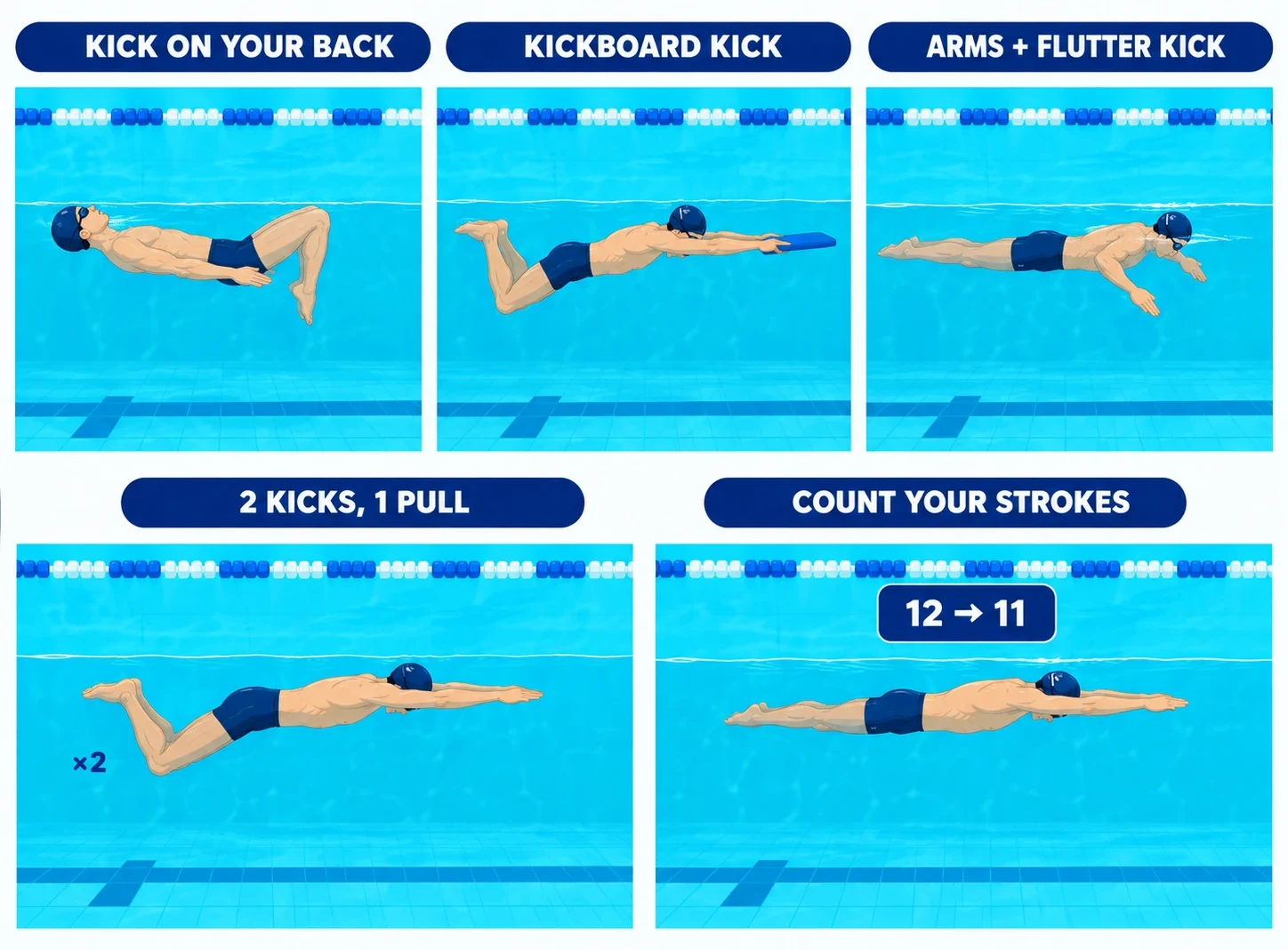
Breaststroke drills split the stroke into parts so you can fix one thing at a time. These five cover almost everything above:
- Kick on your back. Lie on your back, arms by your sides, and kick breaststroke. Your heels should brush your fingertips as they come up, and your knees should stay under the water. If your knees pop out, you’re pulling them toward your chest.
- Kickboard kick, face in. Hold a kickboard, face in the water, and breathe every second or third kick. Focus on flexed feet and a snap together at the end.
- Breaststroke arms with a small flutter kick. The flutter kick keeps your legs up so you can feel the pull on its own. Keep it small and in front of your shoulders. This is a drill only, since a flutter kick isn’t allowed in breaststroke races.
- Two kicks, one pull. One full stroke, then an extra kick while your arms stay stretched out in front. It forces a long glide and teaches your legs to work while your arms are still.
- Stroke count. Swim 25 meters of easy breaststroke and count your strokes. Try to take one fewer on the next length without swimming harder.
Here’s a four-week plan built from those drills. Swim it two or three times a week, warm up with five minutes of easy freestyle or backstroke first, and rest 20 to 30 seconds between lengths.
| Week | Focus | Main set | You’re ready to move on when |
|---|---|---|---|
| 1 | The kick | 6 × 25 m kickboard kick, 4 × 25 m kick on your back | Both feet turn out and your knees stay under the water |
| 2 | Pull and breathing | 6 × 25 m arms with flutter kick, 6 × 25 m full stroke with a steady exhale | You’re breathing every stroke without gasping |
| 3 | Timing | 8 × 25 m two kicks one pull, 4 × 50 m full stroke | You can feel the glide after every kick |
| 4 | Putting it together | 4 × 50 m stroke count, then 200 m easy continuous breaststroke | 200 m feels smooth and your stroke count is dropping |
If week 1 takes two weeks, that’s fine. The kick is the slowest part to learn, and there’s no point building on a screw kick.
How to Swim Breaststroke Without Hurting Your Knees
Breaststroke is the one stroke with an injury named after it. In a study of 36 competitive breaststrokers published in the American Journal of Sports Medicine, Rovere and Nichols found that 86% had had breaststroke knee pain at least once, and 47% had it every week. Pain was more common in swimmers who did more breaststroke training and shorter warm-ups. A larger survey of 391 swimmers by Vizsolyi and colleagues found knee pain in 73% of breaststroke specialists. It also found that injury rates rose sharply when the hips opened less than 37 or more than 42 degrees at the start of the kick, in other words when the knees were too narrow or too wide.
Both studies looked at competitive swimmers doing thousands of meters a week, so the numbers don’t transfer straight to someone swimming 20 lengths on a Tuesday evening. The mechanics are the same, though, and the fixes follow from what the researchers found.
Warm up with five to ten minutes of easy freestyle or backstroke before you do any breaststroke kicking, and add breaststroke distance gradually rather than jumping from two lengths to forty in a week. Keep your knees in the middle zone from the kick section, narrower than a big frog kick and wider than a racer’s whip. Rovere and Nichols also found less internal rotation at the hip in the swimmers with frequent pain, so hip mobility work on land is worth the ten minutes.
If you feel a sharp pain on the inside of the knee, stop kicking breaststroke for that session and switch to freestyle, or to breaststroke arms with a flutter kick. If it keeps coming back, see a physiotherapist before you try to swim through it.
How We Teach Breaststroke at Win and Swim
At Win and Swim we treat freestyle as the main stroke, because it’s the most efficient way to swim any distance. Breaststroke gets taught alongside it. Our beginner group introduces basic breaststroke with the other strokes, and the proper breaststroke technique work (timing, the glide, fixing the kick) happens in our intermediate swimming lessons, where breaststroke coordination sits next to freestyle efficiency.
Most of the faults above are hard to feel from inside the stroke. From the pool deck, a screw kick or a late kick shows up within one length, while the swimmer doing it can go years without noticing. A lot of what we do in our small groups in Amsterdam-Noord is exactly that: watching a length and telling you which of the seven mistakes is yours.
Frequently Asked Questions
Is breaststroke easier than freestyle for beginners?
Breaststroke feels easier at first because the head can stay above water and breathing is simple. Swum properly, with the face in the water and a timed glide, breaststroke is one of the harder strokes to coordinate. Many coaches teach freestyle as the main stroke and breaststroke alongside it.
Are you supposed to breathe every stroke in breaststroke?
Yes. Breaststroke uses one breath per stroke cycle, taken as the arms sweep in and the chest rises. Breathing out underwater during the kick and glide makes each breath in quick and relaxed.
What is the difference between a frog kick and a whip kick in breaststroke?
A frog kick opens the knees wide and sweeps the legs in a big, slow circle. A whip kick keeps the knees about hip-width apart while the feet snap out and round, which is faster and is what competitive breaststrokers use. For most adult swimmers, a kick between the two is the most comfortable on the knees.
What is an illegal breaststroke kick?
Under World Aquatics rules, both legs must move at the same time and both feet must turn outward during the propulsive part of the breaststroke kick. A scissor or screw kick, alternating leg movements, or a downward dolphin kick is illegal in races. The one exception is a single dolphin kick allowed after the start and after each turn.
Why am I so slow at breaststroke?
Slow breaststroke usually comes from timing: pulling and kicking at the same time, or skipping the glide after the kick. Other common causes are pulling back past the shoulders, keeping the head up for the whole length, and kicking with pointed toes instead of flexed, turned-out feet.
Get the order right first (arms, then legs, then a proper glide) and every other fix on this page gets easier.
Written by
Vlad Paturca
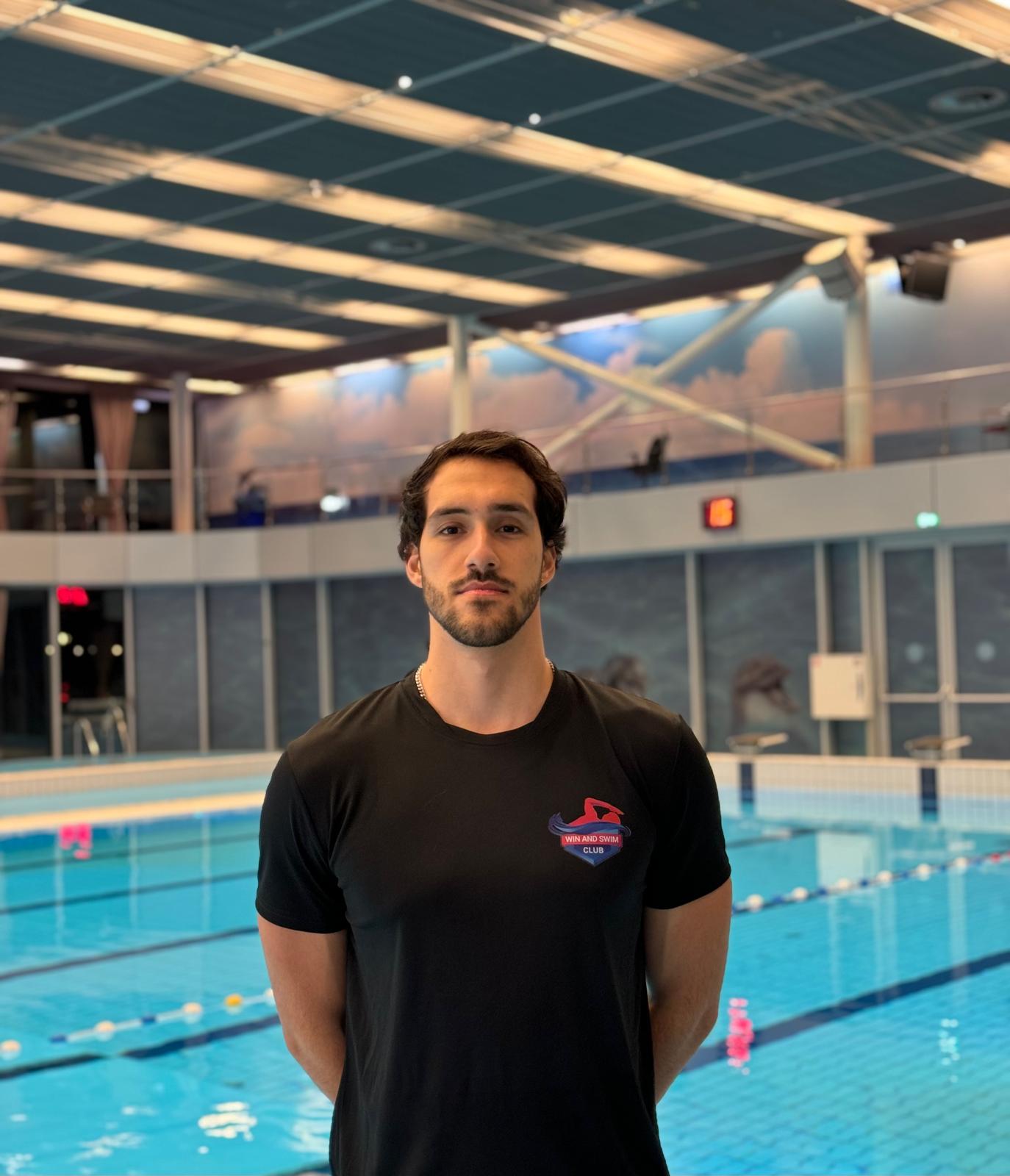
KNZB-certified swim coach, former Romanian national and international freestyle medalist, and founder of Win and Swim Amsterdam. Passionate about adult learners and evidence-based technique. With a bachelor degree in swimming and a first aid course, swimming is my element.
More about Win and Swim →