How to Tread Water: A Coach’s 10-Minute Method for Adults

How to Tread Water: A Coach’s 10-Minute Method for Adults
 Vlad Paturca
On this page
Most adults who struggle in the deep end share the same instinct: kick harder. It feels logical. It is also the fastest way to burn out your legs and slip under.
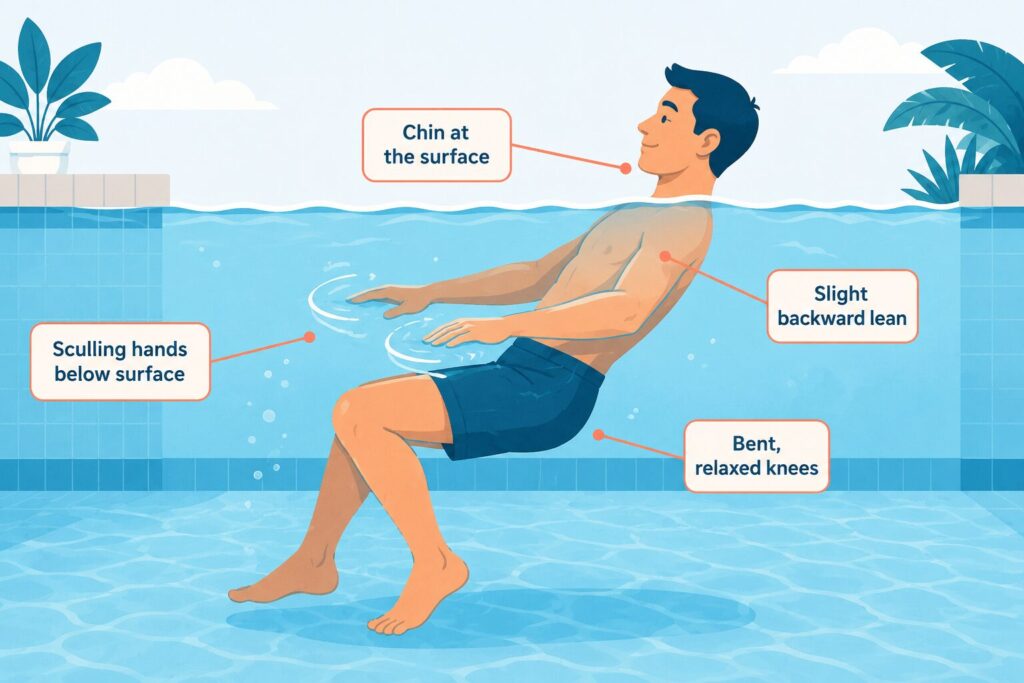
Here’s how to tread water: lean back slightly, as if settling into a reclining chair, keep your chin at the surface, sweep your hands back and forth just below the water in a motion called sculling, and kick slowly with bent, relaxed knees. Done well, treading costs little more energy than standing still on land. The technique matters because the stakes are real. The World Health Organization’s first Global Status Report on Drowning Prevention (2024) counted around 300,000 drowning deaths worldwide in a single year, and the ability to stay calm and vertical in deep water is one of the core skills that prevents them.
Quick answer: Sit back in the water like you’re in a reclining chair. Chin at the surface. Sweep your hands side to side just underwater, palms tilted like windshield wipers. Kick slow and wide with soft knees. Small movements, steady breathing.
We teach this skill in every course at Win and Swim, and we’ve built this article around the same 10-minute method we use in the pool in Amsterdam-Noord. Most adults get their first calm, unassisted 30 seconds inside one session.
Treading Water for Beginners: Get the Body Position Right First
Before any kick or arm movement, fix your posture. Treading water for beginners fails most often because of position, and everything else compensates for that mistake.
Picture a reclining chair. Your torso leans back about 10 to 15 degrees, your hips sit slightly forward of your shoulders, and your knees are bent and loose. Your chin stays at the surface. The back of your head can touch the water. That’s it. That’s the whole secret most people never learn.
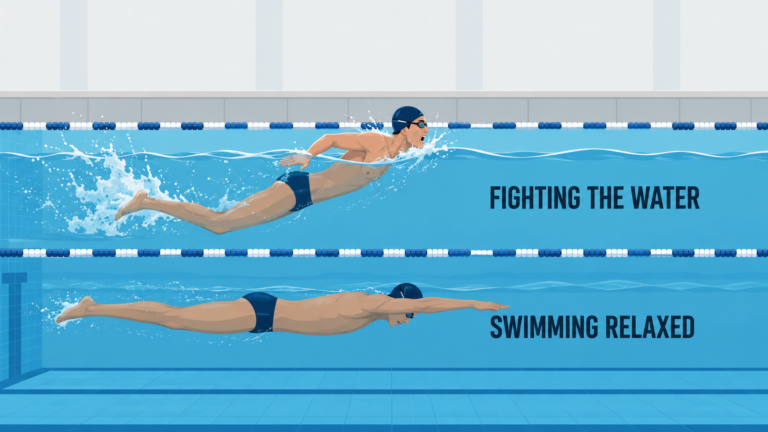
Height is the enemy. Every centimeter of body you lift above the surface must be paid for with leg power. Watch a water polo player between plays: only their head shows. Beginners try to hold their shoulders dry like they’re climbing an invisible ladder, and they exhaust themselves in under a minute.
Two position mistakes we correct in nearly every first lesson of our beginner swimming lessons:
- Tilting the head back to look at the sky. It feels safer, but it arches your back, drops your hips, and turns your tread into a slow backward fall. Eyes forward, chin at the water.
- Going rigid. Tense muscles are denser and less buoyant, and they drink energy. If your jaw is clenched, your whole body is clenched.
The Eggbeater Kick and Two Simpler Ways to Kick
There are three kicks worth knowing, and you don’t need the hardest one on day one.
| Kick | How it works | Effort level | Best for |
|---|---|---|---|
| Flutter kick | Alternating up-and-down leg beats, like vertical freestyle | Moderate, tires calves quickly | Your first session; it’s intuitive |
| Breaststroke (frog) kick | Both legs sweep out, back and down together, then glide | Low, with a bobbing rhythm | Most adults’ long-term default |
| Eggbeater kick | Legs circle in opposite directions, one clockwise, one counterclockwise | Lowest once learned, hardest to master | Steady, bob-free treading; the gold standard |
The eggbeater kick is what lifeguards, water polo players and artistic swimmers use, and for a reason: because one leg is always pushing down while the other recovers, the support never stops. No bobbing, no dead spot, no wasted lift.
Learn it on land first. Sit on the pool edge or a chair with your legs dangling. Circle your right lower leg counterclockwise, from the knee down. Stop. Circle your left lower leg clockwise. Stop. Now run both at once, offset so that when one foot is under your body, the other is out wide. Slow and sloppy is fine. Your hips learn the pattern within a few minutes, and the water makes it easier than the chair does.
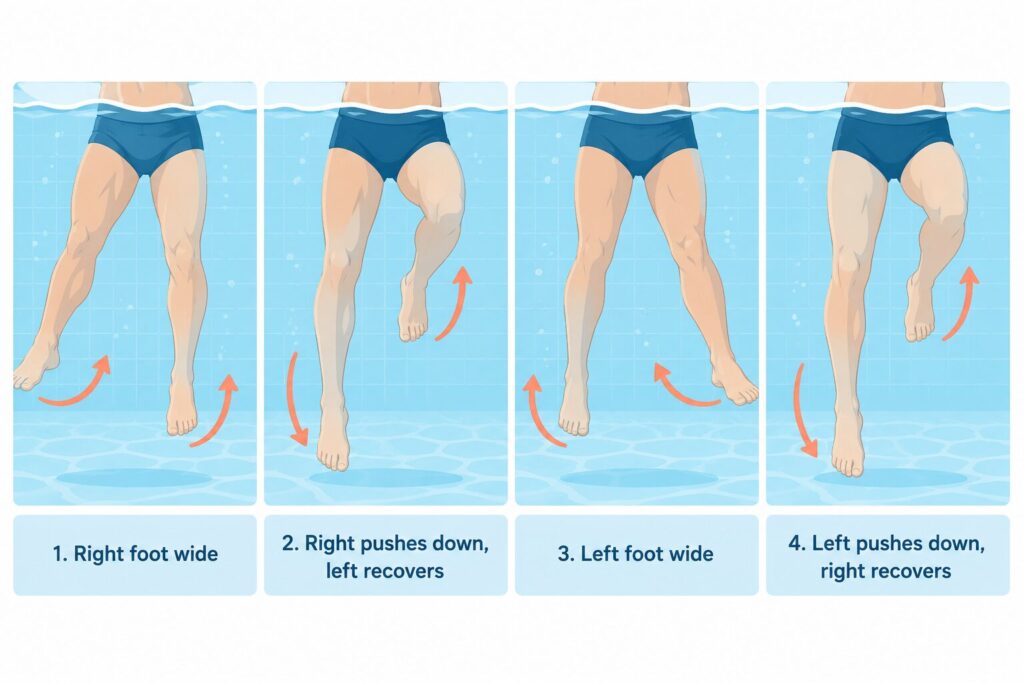
Until the eggbeater clicks, use the breaststroke kick. Kick down and slightly back instead of straight back as you would when swimming, let yourself rise, and rest during the glide. The gentle bob is normal.
Sculling: Your Hands Do Half the Work
Ask a beginner to tread and they’ll thrash their legs while their hands do nothing useful. Coaches see the opposite truth: skilled treaders get 40 to 50 percent of their support from a quiet hand movement called sculling.
Hold your hands 15 to 30 cm below the surface, fingers together, palms facing down but tilted 30 to 45 degrees. Now sweep them outward and inward, like windshield wipers or like you’re smoothing sand in front of you. Tilt the palms out on the outward sweep, in on the inward sweep. You should feel the water turn heavy against your palms and forearms on every pass. That heaviness is lift.
Three details that make sculling work:
- Bend from the elbow. The forearm and palm move; the shoulder mostly doesn’t.
- Keep the sweeps narrow. Wide, dramatic sweeps push you around the pool instead of holding you up.
- Never point your fingertips down. Water slides off a vertical hand, and you lose the pressure you just built.

Coach’s tip: If you’re moving around the pool while treading, your scull is steering instead of supporting. Shrink the movement until you stay put.
How to Tread Water in 10 Minutes: The Session Plan
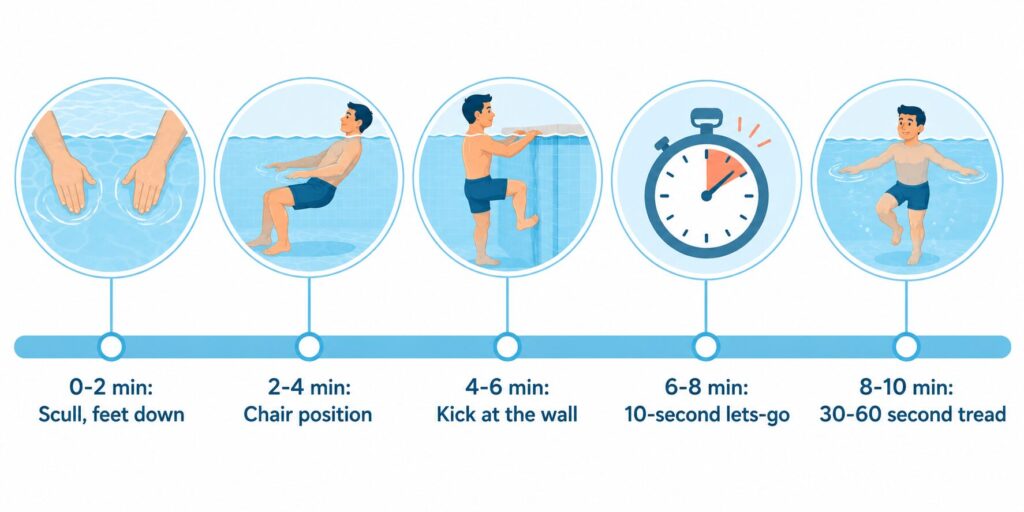
This is the exact progression we run with adult beginners. You need a pool with a deep section, the wall within arm’s reach, and ideally someone nearby. Never practice deep-water skills alone.
| Minutes | Where | What you do |
|---|---|---|
| 0 to 2 | Shoulder-deep water, feet on the floor | Scull only. Hands underwater, windshield-wiper sweeps, until the water feels heavy on your palms |
| 2 to 4 | Same spot | Add the chair position: lean back, bend your knees, let your feet float off the floor for 3 to 5 seconds at a time while sculling |
| 4 to 6 | Deep end, one hand on the pool edge | Practice your kick (breaststroke or flutter) in the vertical position, other hand sculling |
| 6 to 8 | Deep end, next to the edge | Let go for 10 seconds, then hold the wall and rest. Repeat 4 to 6 times. Focus on slow exhales |
| 8 to 10 | Deep end, next to the edge | One continuous tread of 30 to 60 seconds. If you tire, roll onto your back, float, recover, roll back |
That last move deserves its own sentence: rolling onto your back is your reset button. A back float gives you unlimited air for zero effort, and switching between treading and floating is exactly how trained swimmers handle long stays in deep water. If your legs sink when you try to float, our post on fixing sinking legs covers why and what to do about it.
How to Tread Water Without Getting Tired
Once you can tread for 30 seconds, endurance is almost entirely a technique problem. Adults who tire fast are usually making one of these four mistakes.
Kicking too hard. More power feels like more safety. It isn’t. Your legs are the biggest muscles in your body, and running them at sprint intensity empties the tank in a minute or two. Aim for the smallest kick that keeps your chin at the surface.
Riding too high. If your shoulders are dry, you’re doing several times the necessary work. Let the water carry everything below your chin.
Holding your breath. A held breath tightens your chest and shortens the next inhale, and the tension spreads. Breathe in through your mouth, then release slowly and evenly. Full lungs also act as a buoy: exhale everything at once and you’ll feel yourself drop.
Fighting instead of pausing. Treading is a marathon pace, and marathons include drink stations. Alternate: 30 seconds of treading, then 10 seconds of back floating. You’ll last many times longer than someone grinding without a break.
In our lessons we tell students the split should feel like 80 percent legs, 20 percent hands, all of it lazy. If anything burns, something in the technique is wrong, and slowing down usually fixes it.
That same rule, relax, breathe out, and let the water do the work, is what keeps you going once you’re swimming and not just treading water. If freestyle leaves you winded after a length or two, here’s how to swim without getting tired.
Why We Drill This in Every Amsterdam-Noord Lesson
The Netherlands takes this skill seriously enough to test children on it. Under the national Zwem-ABC diploma system managed by the Nationale Raad Zwemveiligheid, a child earning even the first diploma (A) must tread water for 60 seconds, including two full rotations. Many of the adult expats we coach in Amsterdam-Noord never went through that system, so they can often swim lengths yet feel real fear the moment they can’t touch the bottom.
I remember a student who swam a tidy 25-meter freestyle but gripped the lane rope like a lifeline every time she reached the deep end. We spent one session on the chair position and a slow scull, nothing else. By the end she treaded for 90 seconds, and her words afterward stuck with me: “I thought I was a bad swimmer. I just never learned to stop.”
That’s the point of treading water. It’s the skill of stopping: to rest, to think, to fix a leaky goggle, to wait for help. It matters even more outside the pool, where canals, lakes and the North Sea add cold and current; our guide to cold water shock explains why the first minute in open water is the one to train for.
FAQ
How long should an adult be able to tread water? A good first goal for an adult is 60 seconds of calm treading, the same benchmark the Dutch Zwem-ABC Diploma A sets for children. Two minutes without stress is a solid safety standard, and it is the duration many lifeguard certifications require.
What is the easiest way to tread water for beginners? The easiest method for beginners combines a reclined body position (like sitting in a reclining chair), a breaststroke kick directed downward, and sculling hand sweeps just below the surface. This combination needs less coordination than the eggbeater kick and keeps effort low.
Why do I sink when I try to tread water? Sinking while treading water usually comes from technique: holding the body too vertical and rigid, kicking without sculling, or exhaling all air at once. People with high muscle density float lower in the water, but correct technique keeps even lean, muscular adults at the surface.
What is the difference between treading water and floating? Floating is passive: you lie on your back and let buoyancy hold you, which costs almost no energy but limits your view. Treading water is active: you stay vertical using leg kicks and hand sculling, so you can look around, talk, and react. Swimmers combine both, treading to observe and floating to rest.
Is treading water a good workout? Yes. Treading water is a low-impact, full-body exercise that works the legs, core and shoulders while raising your heart rate. Vigorous treading, especially with the eggbeater kick, is a standard conditioning tool in water polo training.
You now know more about staying afloat than most people who swim every week, so take it to the deep end and practice stopping.
Written by
Vlad Paturca
KNZB-certified swim coach, former Romanian national and international freestyle medalist, and founder of Win and Swim Amsterdam. Passionate about adult learners and evidence-based technique. With a bachelor degree in swimming and a first aid course, swimming is my element.
More about Win and Swim →