How to Overcome Fear of Water as an Adult: A Coach’s Step-by-Step Guide

How to Overcome Fear of Water as an Adult: A Coach’s Step-by-Step Guide
 Vlad Paturca

On this page
You’re not broken, and you’re not too old. Fear of water is one of the most common phobias there is: the Cleveland Clinic estimates that 2 to 3 percent of people have aquaphobia, a diagnosable fear of water. Here’s the part that matters more: with gradual exposure, as many as 9 in 10 people with a specific phobia see their symptoms improve. That’s the same method we use in the pool every week.
I’ve coached hundreds of adults in Amsterdam-Noord, and the pattern is always the same. The fear isn’t about water. It’s about control. So the plan below doesn’t start with swimming at all. It starts with giving you control back, one small step at a time.
Quick answer: To overcome fear of water as an adult, use gradual exposure: start in shallow water where you can stand, practice exhaling underwater until it feels boring, learn to stand up from a float, then build skills in small weekly steps. Most adults feel a real shift within 6 to 10 sessions. If your fear causes panic symptoms, work with a coach trained in aquaphobia.
Why Are So Many Adults Afraid of Water?
First, understand how normal this is. A Gallup poll commissioned by the Miracle Swimming Institute found that 46 percent of American adults are afraid in deep water in pools, and 64 percent are afraid in deep open water. Nearly half of all adults share some version of your fear. Most just never talk about it.
Aquaphobia rarely comes out of nowhere. In our lessons, the story behind the fear is usually one of these:
- A bad experience as a child. Being dunked, pushed in, or caught by a wave once is enough. The body remembers.
- No exposure growing up. Many of our students grew up in countries where swimming lessons weren’t standard. Water simply stayed unfamiliar, and unfamiliar became scary.
- A parent’s fear, inherited. If your mother gripped your arm near every pool, you learned water is dangerous before you ever touched it.
- Fear of losing control. This is the big one for adults. You can’t breathe whenever you want, you can’t feel the floor, and your brain sounds every alarm it has.
Whatever the source, the mechanism is the same: your nervous system tagged water as a threat, and it fires the alarm before your rational brain gets a vote. That’s why “just relax” advice never works. You can’t reason with an alarm system. You can only retrain it, and retraining happens through small, repeated, successful experiences in water. Psychologists call this exposure therapy, and it’s the most effective treatment for specific phobias.
There’s a practical reason to do this work, too. In 2024, 146 people drowned accidentally in the Netherlands, according to Statistics Netherlands (CBS). We live in a country defined by water: canals, lakes, the sea. Being calm and capable in water here isn’t a luxury.

A Coach’s Step-by-Step Plan to Overcome Fear of Water
This is the progression we use at Win and Swim with fearful adults. Every step has one rule: you only move on when the current step feels boring. Boredom is the signal that your nervous system has stopped treating that situation as a threat.
- Own the fear out loud. Tell the instructor, tell the friend you swim with, tell yourself. Hiding fear costs energy you need for learning.
- Get in where you can stand. Shallow water, hand on the edge. Walk. Feel the floor. Nothing else. Do this until it’s dull.
- Put your face in and exhale. Standing, holding the edge, blow bubbles out of your nose and mouth. This is the single most important drill in this whole plan. Panic in water is almost always breath-holding in disguise.
- Learn to stand up from a float. Before you float, learn the exit: knees to chest, press down with your hands, feet find the floor. Knowing you can always get back to standing is what makes floating feel safe.
- Float with support, then without. Front float holding the wall, then holding a kickboard, then free. Full lungs keep you buoyant, so breathe in deep and let the water hold you.
- Add gentle movement. Push off and glide. Kick a few meters. Distance doesn’t matter; calm does.
- Stack small wins. Each session, repeat what you can already do, then add one small new thing. Progress in fear work is built on repetition, and the repetition is the point.
Coach’s tip: Set a timer for 10 breaths, not 10 minutes. Counting breaths gives your mind a job, and a busy mind has less room for panic.
One caveat on swimming aids, because we used to recommend them more freely than we do now. Noodles and kickboards are a useful bridge in steps 5 and 6, but if you keep using them past that point, your body never learns that the water itself holds you up. That lesson, feeling your own buoyancy, is where confidence actually comes from. Use aids to get to a skill, then put them away.
Once floating feels boring, the milestone that kills the deep-water fear for good is treading water: staying upright and breathing with the bottom out of reach. Here is how to tread water in about ten minutes.
Your First 8 Weeks: Learn to Swim as an Adult, Week by Week
Fear shrinks fastest when it meets a predictable plan. Here’s the schedule we recommend to adults who want to learn to swim, assuming one session per week plus one short practice visit on your own.

| Week | Focus | You know you’re ready to move on when… |
|---|---|---|
| 1 | Walking in shallow water, getting splashed, wetting your face | Standing chest-deep feels boring |
| 2 | Exhaling underwater (bubbles), 10 slow repetitions | You can exhale with your face in without gripping the wall |
| 3 | Standing up from a float, with the coach’s support | You can recover to standing 5 times in a row, calmly |
| 4 | Front and back floats with a kickboard | You float 10 seconds with light support |
| 5 | Unsupported floats | You float 10 seconds and recover on your own |
| 6 | Push-off and glide from the wall | You glide relaxed with your face in the water |
| 7 | Glide plus gentle kick | You cover a few meters without tension |
| 8 | First strokes with breathing rhythm | You swim a short distance and want to keep going |
Some people move faster and some need three weeks on the breathing step alone. Both are normal. The order matters more than the speed. If you want to know what comes after week 8, we wrote a full guide on how many swimming lessons adults need.
Swimming Lessons for Adults Afraid of Water: When to Get a Coach
You can do steps 1 to 3 on your own in any shallow pool. But there’s a point where a coach stops being a nice-to-have:
- You’ve tried alone and hit a wall. Usually at the floating stage. A coach’s hand under your back for two sessions can do what months of solo attempts can’t.
- You get physical panic symptoms. Racing heart, tight chest, shaking near water. That’s aquaphobia territory, and it needs a structured, patient approach.
- You avoid water situations in daily life. Skipping pool parties, dreading boat trips, staying on the beach towel. When fear starts making your decisions, it’s time.
This is exactly why we built our aquaphobia swimming lessons in Amsterdam-Noord. Small groups, warm water, and no step taken before you’re ready for it. Most of our fearful beginners are amazed by what changes in the first month. One of our Win and Swim students, a 38-year-old expat who couldn’t put her face in the water at her first lesson, swam her first full lane within three months. Her breakthrough wasn’t a swimming technique. It was the moment she realised she could always stand up.

Five Things That Keep Your Progress Safe
- Never practice alone in unsupervised water. Pool with a lifeguard, always. Open water comes much later, and we cover that in our open water preparation guide.
- Warm water helps. Cold water triggers a gasp reflex that feels exactly like panic. Learn in a warm pool first. When lakes are on your horizon, our guide to cold water shock explains that reflex in full.
- Stop while it’s still going well. End every session on a success, even a small one. Your brain files the last memory hardest.
- Expect a bad day. One tense session doesn’t erase your progress. Go back one step, rebuild, continue.
- Breathe out, always. When in doubt, exhale. A slow exhale is the fastest way to interrupt panic, in water and out of it.
FAQ
Can an adult really overcome a lifelong fear of water? Yes. Fear of water is a learned response, and learned responses can be retrained at any age. Research cited by the Cleveland Clinic shows up to 9 in 10 people with specific phobias improve with exposure-based treatment. Adults in structured lessons typically feel a clear shift within 6 to 10 sessions.
What is aquaphobia exactly? Aquaphobia is an intense, persistent fear of water that triggers anxiety or panic symptoms even when the water poses no real danger. It affects an estimated 2 to 3 percent of people. It differs from ordinary caution because the fear is out of proportion to the situation and leads to avoidance.
How long does it take to overcome fear of water? Most adults who train once a week feel noticeably calmer in water within 4 to 8 weeks and can float and glide within about 8 weeks. People with strong panic symptoms may need a few months of slower, structured exposure. Speed matters less than never skipping a step.
Is it better to overcome fear of water alone or with an instructor? The first steps, like walking in shallow water and exhaling underwater, work fine alone in a supervised pool. From the floating stage onward, an instructor trained in fearful adults makes progress faster and safer, especially for anyone who experiences physical panic symptoms near water.
Why do I panic when water touches my face? Water on the face triggers instinctive breath-holding, and breath-holding creates the tight-chest feeling people read as panic. The fix is training a slow exhale with your face in the water, repeated until it becomes automatic. This single drill resolves most face-in-water panic.
Every confident swimmer you’ll ever meet started exactly where you are now: at the edge, deciding whether to get in.
Written by
Vlad Paturca
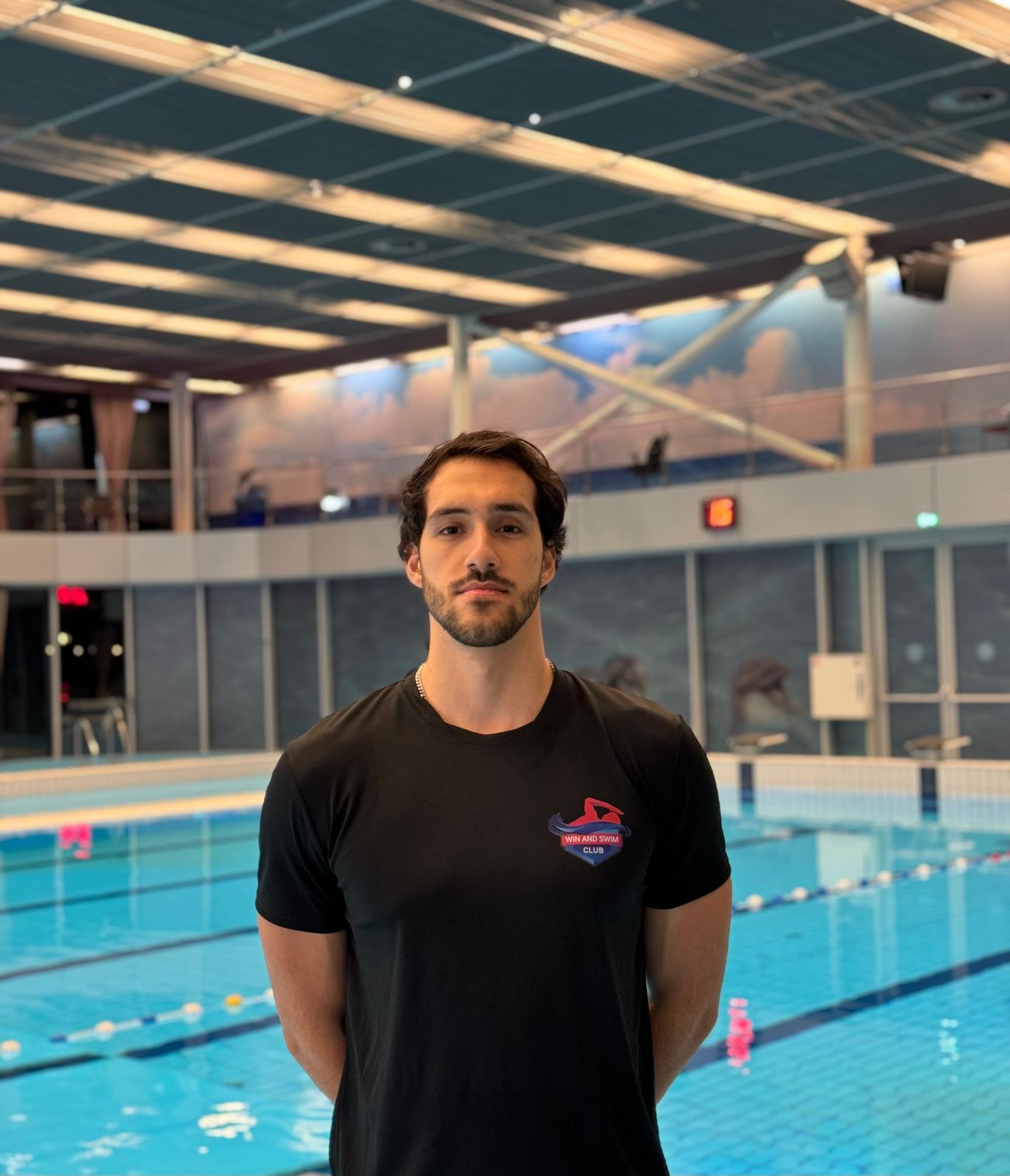
KNZB-certified swim coach, former Romanian national and international freestyle medalist, and founder of Win and Swim Amsterdam. Passionate about adult learners and evidence-based technique. With a bachelor degree in swimming and a first aid course, swimming is my element.
More about Win and Swim →