How to Swim Without Getting Tired: A Coach’s Guide to Swimming Longer
Out of breath after one length? Here's how to swim without getting tired, from a coach: fix your body position, breathing, pacing and kick to swim longer.

How to Swim Without Getting Tired: A Coach’s Guide to Swimming Longer
 Vlad Paturca

On this page
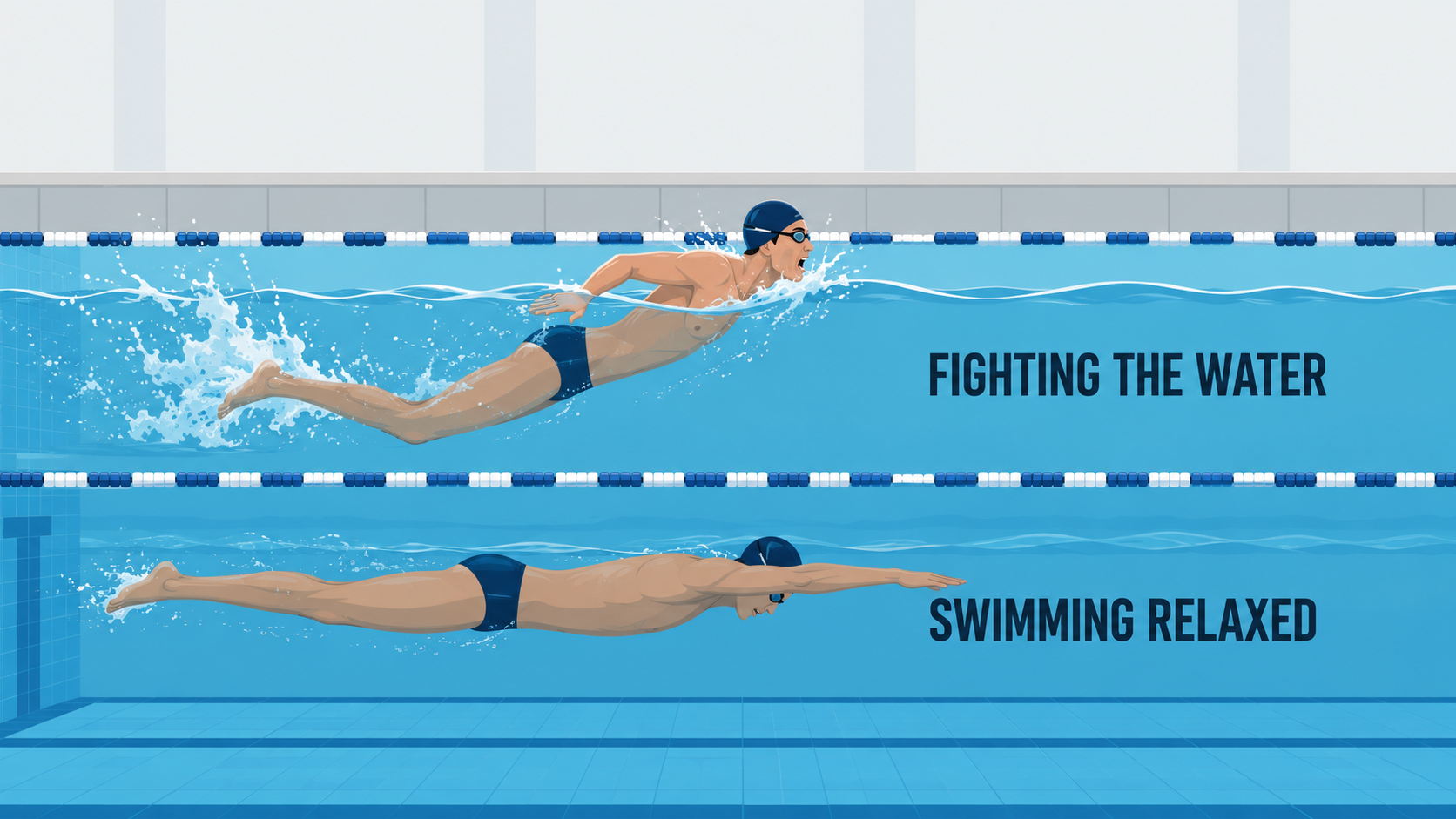
You push off the wall, swim one length, and grab the side gasping. Your legs feel like concrete and your heart is hammering. Sound familiar? Here’s the good news: if you get tired fast in the pool, the problem is almost never your fitness. It’s efficiency. Most adults who feel wrecked after 25 metres are fighting the water instead of moving through it, and that wastes a huge amount of energy.
The short version of how to swim without getting tired: relax and lengthen your stroke, breathe out continuously into the water, keep your body flat to cut drag, ease off the kick, and slow down to a pace you can actually hold. Do those five things and you’ll swim longer almost straight away, before you’ve gained a single bit of fitness.
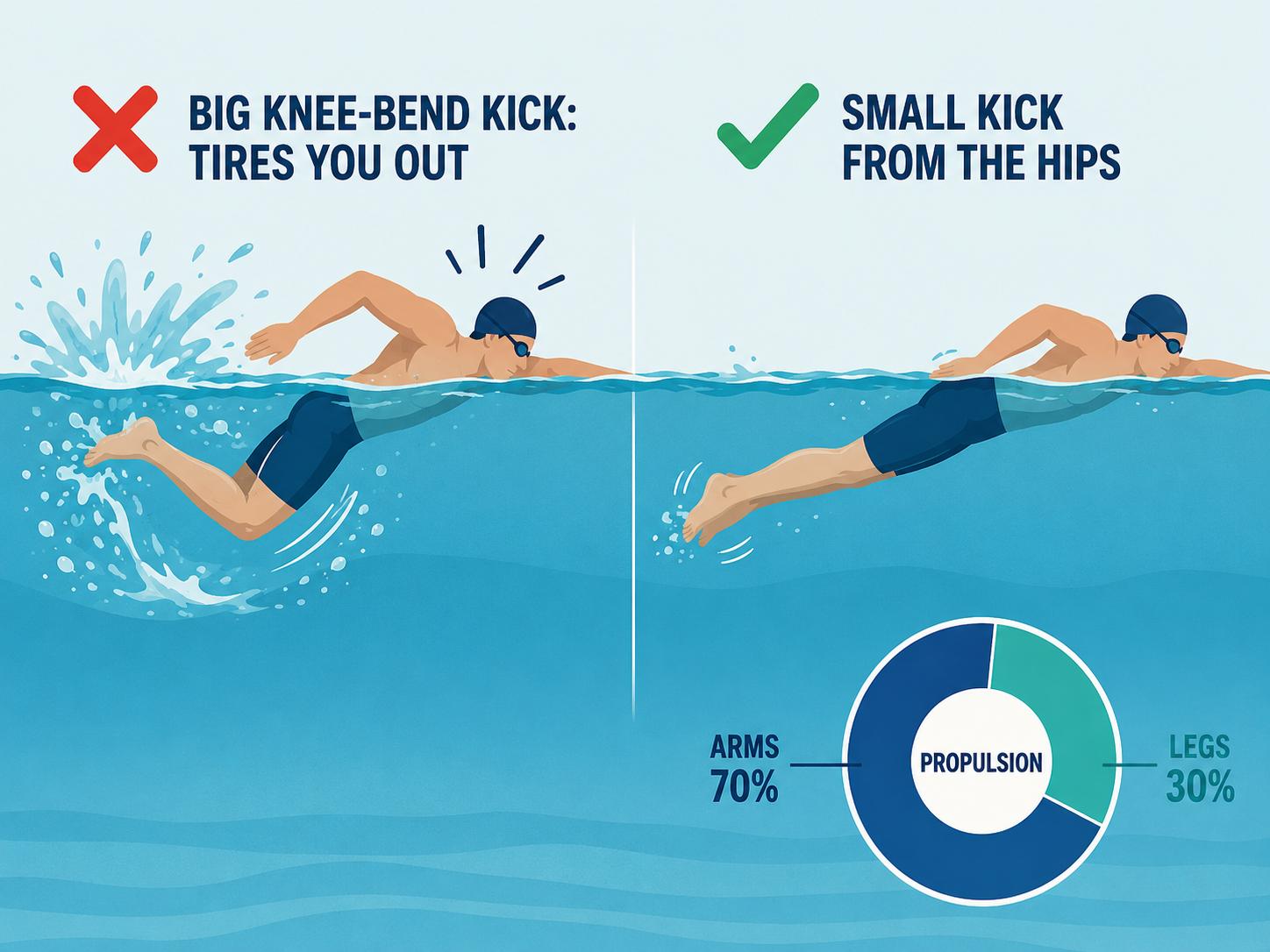
That isn’t just coach talk. In front crawl the arms do most of the work. A study of fully tethered swimming published on PubMed Central measured the arms producing around 70% of a swimmer’s propulsion, with the legs contributing the rest. So when beginners kick furiously, they’re draining their biggest, most oxygen-hungry muscles for a small share of the forward drive. No wonder they run out of air.
Quick answer: You get tired swimming mainly because poor technique wastes energy, not because you’re unfit. Fix your body position, breathe out underwater, stop over-kicking, and pace yourself, and most adults can swim noticeably longer within a few weeks.
Why You Get Tired So Fast When You Swim
Swimming punishes wasted effort more than any other sport. On land, poor running form just slows you down a little. In water, every drop of tension and every centimetre of drag costs you, because water is roughly 800 times denser than air. Fight it and it fights back.
So before we fix anything, let’s find your specific leak. Almost everyone who asks me “why do I get tired swimming?” has one main culprit, and it’s usually one of six. Tap yours below and I’ll tell you the cause and the fix.
Why am I getting tired in the water?
Tap what happens to you first. Most swimming fatigue is a technique leak, not poor fitness.
Whatever you tapped, the rest of this guide walks through the fixes in the order they matter most. Start at the top, because body position changes everything downstream.
Fix Your Body Position First
If your legs sink, you’ve turned yourself into an anchor. A swimmer dragging their hips and legs through the water can face several times more resistance than one lying flat on the surface, and you pay that tax on every single stroke. This is the first thing we check, and it’s the fastest win for swimming longer.
The fix is counterintuitive: look down, not forward. Most tired swimmers lift their head to see where they’re going, and the moment the head goes up, the legs go down, like a seesaw. Instead, look straight at the bottom of the pool and press your chest very lightly into the water. Your hips and legs will float up behind you, and suddenly you’re gliding instead of ploughing.
Keep one long line from your fingertips to your toes. Swimmers call it streamline, and it’s the shape you want to hold for as much of each stroke as possible. If sinking legs are your main issue, we’ve written a full fix here: how to stop your legs from sinking.
Body position is one piece of a bigger picture. If your whole stroke needs tidying, not just your legs, work through how to swim properly first, then come back and layer the pacing on top.

Breathe So You Never Run Out of Air
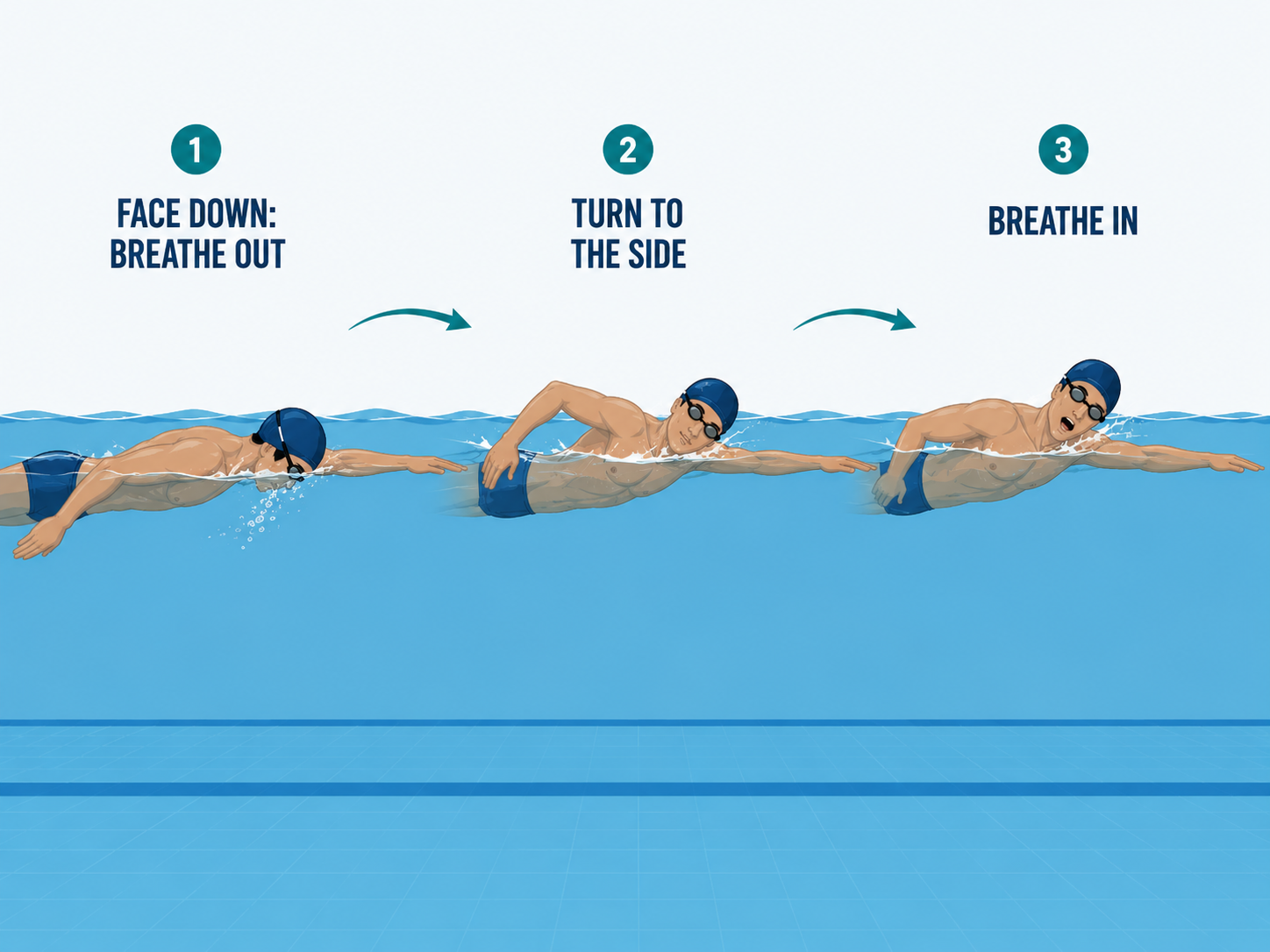
Here’s the single most common reason adults gas out: they hold their breath. It feels natural to take a big breath, put your face in, and hold it until you turn to breathe again. It’s also exactly wrong. Holding your breath traps carbon dioxide, and it’s the rising CO2, not a lack of oxygen, that gives you that desperate, panicky urge to breathe.
The rule is simple. When your face is in the water, you should be breathing out, gently and constantly, through your nose and mouth. This is sometimes called trickle breathing. When you turn to the side, your only job is to breathe in, because your lungs are already empty and ready. Breathe out in the water, breathe in over the water. Never hold.
Get your rhythm relaxed rather than rushed. Many adults do best breathing every two or three strokes; don’t force bilateral breathing if it makes you tense. For a deeper walkthrough, read freestyle breathing made simple. Sort your breathing out and most of the “I can’t swim more than a length” problem disappears on its own.
Stop Over-Kicking: Your Legs Are Draining Your Tank
Watch a nervous adult swimmer and you’ll often see a furious, thrashing kick. It feels like effort, so it feels like it must be helping. It isn’t. Your leg muscles are the largest in your body, and they demand a lot of oxygen for the propulsion they return. Remember that tethered-swimming research: the arms drive most of you forward, so a giant kick spends your energy budget in the worst possible place.
For swimming longer without getting tired, you want a small, steady kick that comes from the hips, not the knees, with relaxed ankles and pointed toes. Think of it as a gentle flutter that keeps your legs up, not a motor. Many efficient distance swimmers use a light two-beat kick, just two kicks per arm cycle. Save the big kick for the last few metres of a race you’re never going to swim.
If you want to feel the difference, try this in your next session: swim a length with a kickboard doing your normal hard kick, note how quickly your legs burn, then swim a length with a tiny, lazy kick and let your arms lead. Almost everyone travels just as far on the lazy kick, for a fraction of the cost.
How to Swim Without Getting Tired Comes Down to Pace
You can have flawless technique and still blow up if you swim too fast. Pacing is the skill that separates people who swim one frantic length from people who cruise for twenty minutes. Almost every gasping beginner is simply swimming at a sprint pace they can hold for exactly one length, then wondering why they can’t hold it for two.
The best endurance athletes have known this for years. Research led by exercise physiologist Dr. Stephen Seiler found they spend about 80% of their training at an easy, conversational effort and only around 20% going hard. It’s called the 80/20 rule, or polarized training, and it builds endurance faster than grinding every length at maximum effort. Most tired swimmers do the opposite: 100% moderate-to-hard, all the time.
| Effort zone | How it should feel | How much of your pool time |
|---|---|---|
| Easy (aerobic) | Relaxed, you could hold a conversation | About 80% |
| Endurance (your CSS) | Comfortably hard, controlled, sustainable | Most of the other 20% |
| Fast reps | Genuinely hard, short efforts only | A small slice |
So what’s your easy pace, in real numbers? The simplest way to find it is your Critical Swim Speed, or CSS: the pace you can hold for a long, steady swim. Do two honest time trials with full rest between them, a 400 metre and a 200 metre, then drop the times into the calculator below. It gives you your sustainable pace per 100 metres and your training zones.
Find your sustainable swim pace
Swim two all-out time trials with full rest between them: a 400 m and a 200 m. Enter your times and this works out the pace you can actually hold, plus your training zones.
per 100 m
This is your Critical Swim Speed: the pace you can hold for a long, steady swim before fatigue takes over.
| Easy / long aerobic swims | |
|---|---|
| Endurance sets (your CSS) | |
| Short fast reps |
Aim to spend about 80% of your pool time at the easy pace and only 20% hard. That’s the 80/20 rule, and it builds endurance faster than grinding every length.
Once you know your easy number, swim most of your lengths at or just slower than it. It will feel almost too gentle. That’s the point. Easy swimming is where endurance is built.
How We Build Swimming Endurance at Win and Swim
Technique and pacing get you swimming longer today. To actually build swimming endurance, you need a plan that adds distance gradually, so your body adapts instead of breaking down. The mistake we see most is people trying to swim 500 metres on day one, failing, and deciding they’re “just not fit enough.”
One of the swimmers I coach here in Amsterdam-Noord is a strong runner who could barely finish 50 metres last winter. Her engine was never the problem. She held her breath and sprinted every length. We slowed her right down, taught her to exhale into the water, and capped her effort. Six weeks later she swam 400 metres nonstop, and she was almost annoyed at how simple the changes were.
Here’s a four-week progression that follows the same logic. Swim it two or three times a week, keep everything at your easy CSS pace, and rest as long as you need between reps.
| Week | Main set (easy pace) | Focus |
|---|---|---|
| 1 | 8 × 50 m, rest 20 sec | Groove technique, never redline |
| 2 | 6 × 75 m, rest 20 sec | Extend the distance without speeding up |
| 3 | 4 × 100 m + 1 × 200 m steady | Hold your form past 100 m |
| 4 | 300 m to 400 m continuous, easy | Your first long unbroken swim |
That’s the exact structure behind our intermediate swimming lessons, which are built for adults who can already swim about 25 metres and want to pace themselves and extend their distance. If you’d rather have a coach watch your stroke and fix the leak in person, that’s what we do at Win and Swim in Amsterdam-Noord. A single set of eyes on the pool deck often saves months of frustration.
How Long Until You Can Swim Without Getting Tired?
This is the question everyone asks, so let’s answer it honestly. The technique changes (body position, breathing, easing the kick, slowing down) can add distance in a single session. It’s common for a swimmer to double how far they can go in one lesson, purely by stopping the things that were draining them.
Building genuine endurance, the kind that lets you swim 400 metres or more without stopping, usually takes a few weeks of consistent, easy swimming. For most adults training two or three times a week, four to eight weeks is a realistic window to go from gassing out at 25 metres to a comfortable continuous swim. Consistency beats intensity every time. Three relaxed swims a week will take you further than one weekly thrash.
Frequently Asked Questions
Why do I get so tired so quickly when I swim?
Almost always because of wasted energy, not poor fitness. Holding your breath, letting your legs sink, kicking too hard, and swimming too fast all drain you within a length or two. Fix those and most adults swim far longer without getting any fitter.
What is the 80/20 rule in swimming?
It means doing about 80% of your swimming at an easy, conversational pace and only about 20% at a hard effort. The approach comes from endurance research by Dr. Stephen Seiler, and it builds stamina more effectively than swimming moderately hard all the time.
Does 1 km of swimming equal 5 km of running?
There’s a common triathlon rule of thumb that swimming is roughly four times as demanding as running for the same distance, so 1 km of swimming is often compared to around 4 km of running. It’s an approximation, not a law. Swimming feels harder mostly because technique, not fitness, limits most people.
How long does it take to build swimming endurance?
Technique fixes can add distance immediately. Building real endurance to swim 400 metres or more continuously usually takes about four to eight weeks of swimming two or three times a week at an easy pace.
How many times a week should I swim to stop getting tired?
Two or three sessions a week is the sweet spot for most adults. That’s frequent enough to build endurance and refine technique, while still leaving time to recover between swims.
Get these fundamentals right and swimming stops feeling like a battle and starts feeling like something you could do all afternoon.
—
Written by
Vlad Paturca
KNZB-certified swim coach, former Romanian national and international freestyle medalist, and founder of Win and Swim Amsterdam. Passionate about adult learners and evidence-based technique. With a bachelor degree in swimming and a first aid course, swimming is my element.
More about Win and Swim →

