The 5 Most Common Swimming Mistakes (And How to Fix Them)

The 5 Most Common Swimming Mistakes (And How to Fix Them)
 Vlad Paturca
On this page
Most adults who feel slow in the water blame fitness. Nine times out of ten, what’s actually holding them back is one of five technique errors, and every one of them is fixable within weeks.
Here’s the short answer: the most common swimming mistakes are lifting your head too high, holding your breath underwater, cutting the arm stroke short, kicking from the knees, and practising without feedback. Swim England‘s technique guidance confirms the second one directly: you should exhale continuously underwater and avoid holding your breath, because a held breath raises tension and wrecks your rhythm. Water is roughly 800 times denser than air, so every one of these errors costs you far more than the equivalent sloppiness would on land.
We see all five weekly in our lessons at Win and Swim in Amsterdam-Noord, usually in swimmers who’ve been repeating them for years. Let’s go through each one.
The 5 Most Common Swimming Mistakes at a Glance
| # | Mistake | What It Costs You | The Fix in One Line |
|---|---|---|---|
| 1 | Lifting your head too high | Hips sink, drag multiplies | Eyes down, rotate to breathe |
| 2 | Holding your breath underwater | CO2 buildup, early exhaustion | Exhale continuously, inhale quick |
| 3 | Cutting the arm stroke short | Choppy stroke, wasted energy | Reach, glide, finish at the hip |
| 4 | Kicking from the knees | Big splash, no propulsion | Drive from the hip, loose ankles |
| 5 | Practising without feedback | Errors become habits | Film yourself or get coached eyes |
Mistake 1: Lifting Your Head Too High
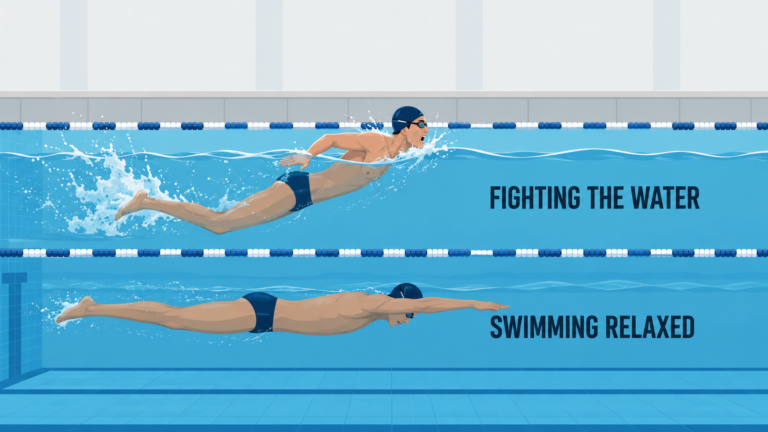
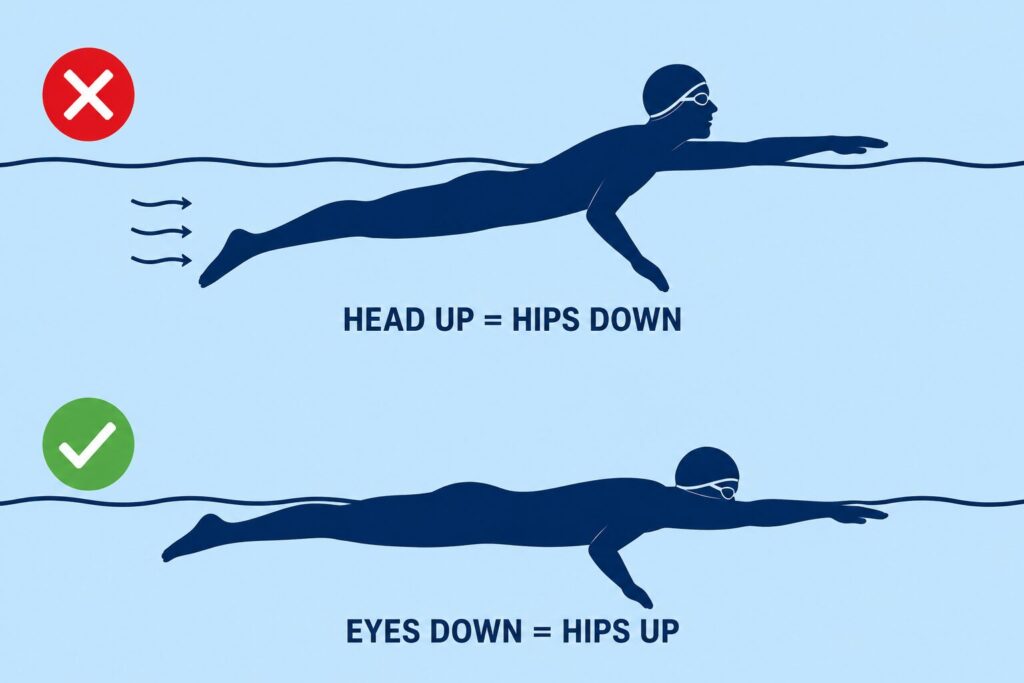
This is the swimming technique mistake we correct most often, and the hardest one to self-diagnose. Your body behaves like a seesaw in the water: when your head comes up, your hips and legs go down. Low hips mean more drag, more effort, and that familiar feeling of fighting the water instead of moving through it.
The fix: look at the bottom of the pool, with your eyes down and your neck neutral. In front crawl, the waterline should sit around the crown of your head. When you breathe, rotate your head to the side with your body roll; one goggle can stay in the water. Lifting your head forward to breathe is the single fastest way to sink your legs.
You won’t feel this mistake from the inside. You’ll swear your head is down while it’s pointing straight ahead. That’s why a recording or a coach’s eye finds it in seconds when years of solo swimming haven’t.
Mistake 2: Holding Your Breath Underwater
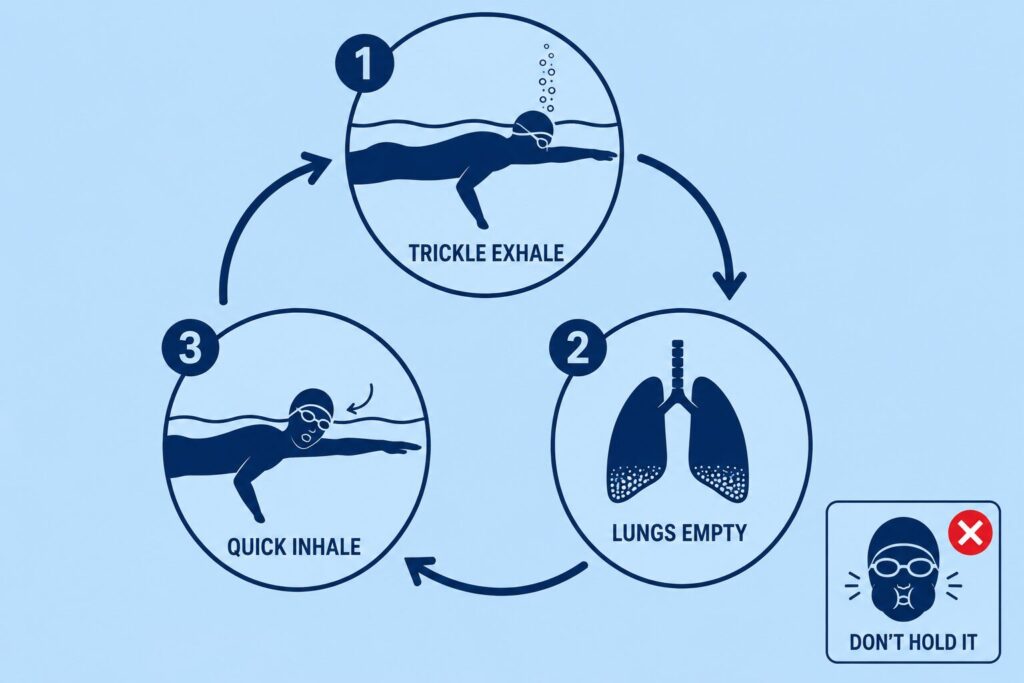
Many adults treat swimming like snorkelling: big gulp of air, hold it, release it just before the next breath. It feels safe. It’s also the main reason people gas out after two lengths.
Holding your breath doesn’t cause hyperventilation. What it does is let carbon dioxide build up in your bloodstream, and CO2, not lack of oxygen, is what creates that urgent, panicky need to breathe. Hold your breath through a length and your body screams for air even though your muscles have plenty of oxygen left.
The fix is trickle breathing: exhale slowly and continuously through your nose or mouth the whole time your face is in the water, so your lungs are nearly empty when you turn to breathe. Then the inhale is quick and easy. Swim England recommends exactly this: exhale underwater, through mouth, nose, or both, either as a steady trickle or in one strong burst at the end. Breathing every three strokes is a sensible starting rhythm in front crawl because it builds bilateral breathing. We’ve broken the whole skill down in freestyle breathing made simple.
Mistake 3: Cutting the Arm Stroke Short
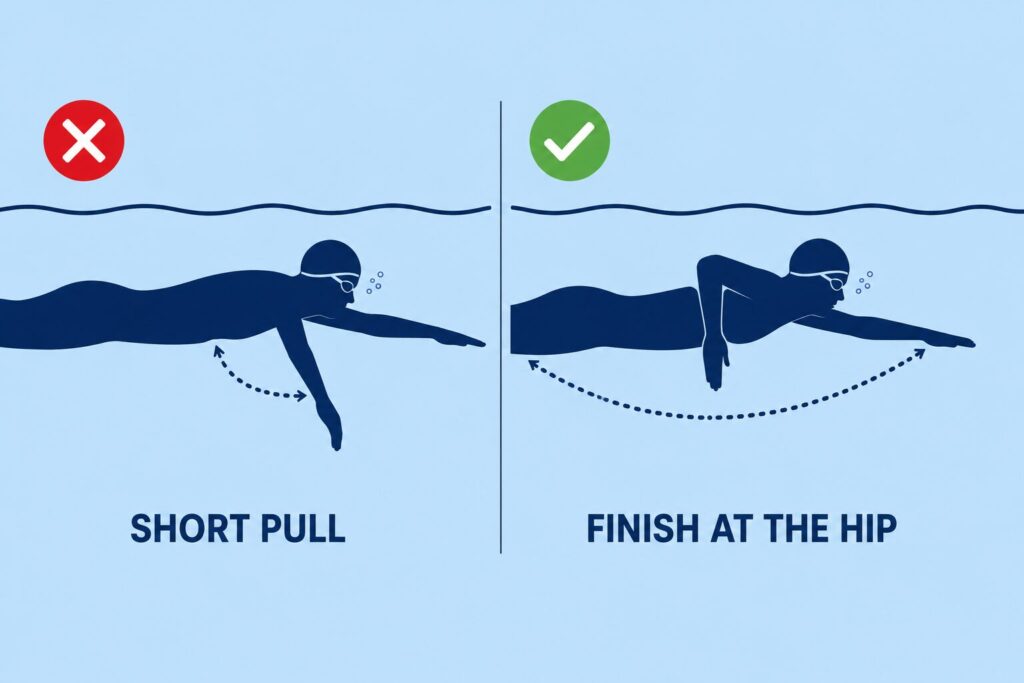
The most common freestyle swimming mistakes live in the arm stroke, and they come in pairs. Swimmers rush the front of the stroke, starting the pull the instant their hand hits the water, and they abandon the back of it, exiting at the ribs instead of pushing through to the hip. The result is a fast, choppy stroke that moves a lot of water and very little swimmer.
Three fixes, in order of impact:
- Finish the stroke. In front crawl and backstroke, your hand should pass your hip before it exits. The final third of the pull is where cheap propulsion lives.
- Reach and glide. Extend the leading arm fully before starting the catch. A useful drill is catch-up freestyle, where one hand waits in front until the other completes its stroke.
- Keep a high elbow underwater. During the pull, bend your elbow so your forearm and hand face backwards like a paddle. Coaches call this the early vertical forearm. A straight arm pressing down on the water lifts you up and slows you down.
Keep your fingers relaxed and close together. A slightly cupped, soft hand grips more water than a rigid one.
Mistake 4: Kicking from the Knees
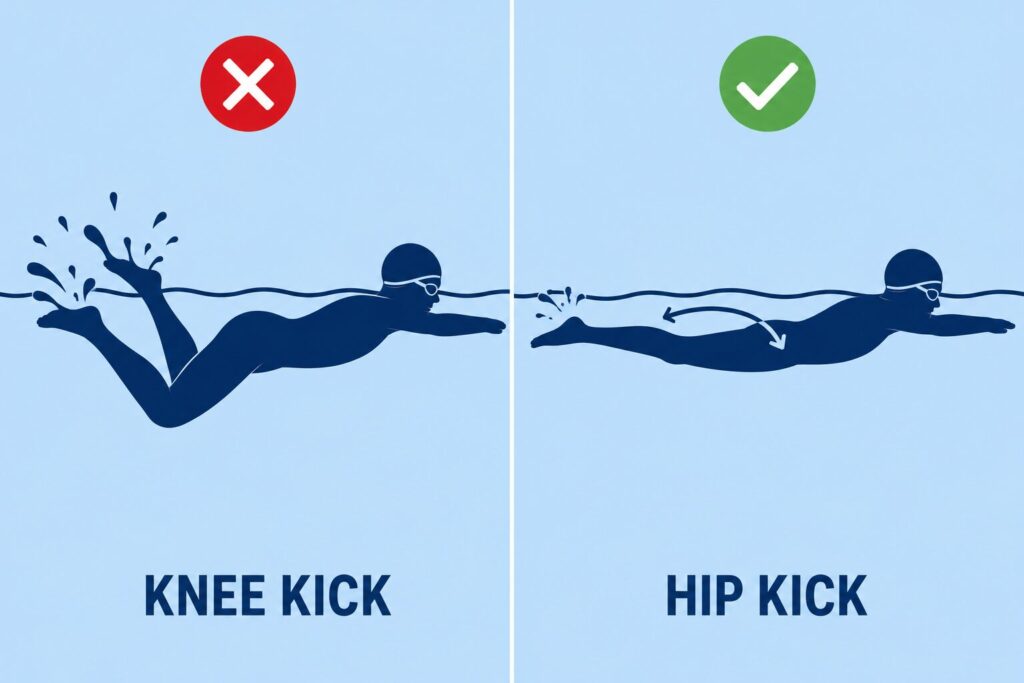
“Bend your knees with every kick” is advice you’ll still hear on pool decks, and it describes the mistake rather than the fix. A flutter kick driven by deliberate knee bending turns into a cycling motion: big splash, huge energy cost, almost no forward movement.
An effective flutter kick starts at the hip. The thigh drives the movement, the knee bends slightly and passively, and the ankle stays loose so the foot can whip like a flipper. Point your toes without cramping them, kick from the top of your foot on the downbeat, and keep the whole kick narrow, inside the shadow of your body. Your heels should just about break the surface.
Stiff ankles and knee-driven kicks are also a major reason legs sink; if that’s your struggle, our beginner balance fix for sinking legs goes deeper into body position.
Mistake 5: Practising Without Feedback
The fifth mistake wraps around the other four. Swimming is uniquely hard to self-correct. You can’t see yourself, water distorts every sensation, and effort feels like progress even when it’s reinforcing an error. Lap after lap, you’re either grooving good technique or grooving bad technique. The water doesn’t care which.
Every mistake on this list is invisible from the inside. You’ll swear your head is down, your stroke is long, your kick is narrow. Without something external (a camera, a training partner, a coach), the swimmer practising a mistake and the swimmer practising good technique feel exactly the same.
How to Fix the Most Common Swimming Mistakes for Good
If you’re serious about learning how to fix swimming technique, build a feedback loop. Film yourself from the side and front once a month; a phone in a waterproof case held by a friend works fine. Swim with someone whose stroke you trust and swap observations. Or get coached eyes on you: in our intermediate swimming lessons at Win and Swim, video review and live correction are the core of every session, because I’ve watched swimmers fix in three weeks what they’d been doing wrong for a decade.
One habit from my own competitive years in the pool: pick one fix per session. Head position on Monday, exhaling on Thursday. Chasing all five at once fixes none of them. Once the five are gone, our guide on how to swim properly puts the whole stroke together.
FAQ
Why do I get tired so quickly when I swim?
Early fatigue in swimming usually comes from technique rather than fitness. The two biggest causes are holding your breath, which builds carbon dioxide and triggers breathlessness, and a high head position, which sinks the hips and multiplies drag.
Should you hold your breath while swimming?
No. Swim England’s technique guidance says to exhale continuously underwater, through your mouth, nose, or both, and to avoid holding your breath. Exhaling underwater keeps you relaxed and leaves only a quick inhale to complete when your face turns out of the water.
How often should you breathe during front crawl?
Breathing every three arm strokes is a good starting rhythm for front crawl because it alternates your breathing side and keeps the stroke symmetrical. Confident swimmers adjust to every two strokes for sprints or open water and every four or more for short, easy efforts.
What is the correct head position for freestyle?
In freestyle, look at the bottom of the pool with a neutral neck, so the waterline sits around the crown of your head. To breathe, rotate your head sideways together with your body roll instead of lifting it forward, keeping one goggle in the water.
Is it better to kick from the hips or the knees?
Kick from the hips. The thigh drives the movement while the knee bends slightly and passively and the ankle stays relaxed. A kick driven by deliberate knee bending creates drag and burns energy while producing very little propulsion.
Fix one mistake at a time, and the water starts helping you instead of arguing with you.
Written by
Vlad Paturca
KNZB-certified swim coach, former Romanian national and international freestyle medalist, and founder of Win and Swim Amsterdam. Passionate about adult learners and evidence-based technique. With a bachelor degree in swimming and a first aid course, swimming is my element.
More about Win and Swim →