Do Expats Need a Dutch Swimming Diploma? (Zwem-ABC)

Do Expats Need a Dutch Swimming Diploma? (Zwem-ABC)
 Vlad Paturca
On this page
Every spring, someone new to the Netherlands asks us the same worried question: “I never got a Dutch swimming diploma. Am I even allowed in the pool?” Short answer: yes, you are. No, expats don’t need a Dutch swimming diploma. There is no law requiring adults (or anyone) to hold one. On 4 April 2025, State Secretary Vincent Karremans confirmed that mandatory school swimming will not return, partly because reintroducing it would cost around €145 million per year. Swimming education here is the responsibility of families, and the diploma system is a voluntary skills framework.
That said, the question deserves a better answer than “no”. The Netherlands is a country where 54% of resident drownings over the past five years happened in ditches, rivers and canals (CBS, 2026). The diploma is optional. The skills behind it are not. Here’s how the system works, when a diploma is worth getting, and what we’d focus on instead.
Why the confusion exists
The Zwem-ABC is everywhere in Dutch life. Colleagues mention their kids’ diploma exams. Pools post signs about diploma requirements for children. Job listings for police or cabin crew ask for swim certificates. It’s easy to conclude that everyone here is legally required to certify.
They aren’t. For children, diploma rules are local pool policy: kids without at least an A diploma are typically restricted to the shallow end and must wear armbands. For adults, no such gate exists. Lifeguards judge you on what you can visibly do in the water.
The government has looked at this question head-on. School swimming was mandatory until 1985. Parliament pushed to bring it back in 2024, and in April 2025 the cabinet declined: too expensive, too time-consuming, and swimming remains the family’s responsibility. So if you’re waiting for a letter demanding your diploma, it isn’t coming.
The Zwem-ABC explained: diploma A, B and C
The Zwem-ABC is the national framework run by the Nationale Raad Zwemveiligheid (NRZ), the Dutch water safety council. Three levels, each building on the last. Diploma C equals the Nationale Norm Zwemveiligheid, the national standard for water safety.
A detail that surprises most expats: every exam is swum partly in clothes. The Dutch logic is blunt. Nobody falls into a canal wearing a swimsuit.
| Diploma A | Diploma B | Diploma C | |
|---|---|---|---|
| What it proves | Basic self-rescue in a pool | Confident swimming, pools with slides and waves | Safe in open water without current |
| Continuous swim | 50 m | 75 m | 100 m |
| Underwater swim | 3 m | 6 m | 9 m |
| Exam clothing | Short-sleeved shirt, long trousers, shoes | Long-sleeved shirt, long trousers, shoes | Long-sleeved jumper, trousers, shoes, jacket |
| Meets national water safety standard? | No | No | Yes |

Adults can take these exams too. Several swim schools in the Netherlands run adult diploma tracks, and the certificates never expire. Which brings us to the real question.
Do adults need a Dutch swimming diploma? Pool rules and job requirements
For everyday life as an adult in the Netherlands: no. We’ve coached hundreds of adults in Amsterdam-Noord, and not one has ever been asked for a diploma at a public pool. Pool access for adults is based on observed ability. If a lifeguard sees you struggling, you’ll be moved to shallow water, diploma or not.
There are a few real exceptions where a swimming diploma for adults in the Netherlands matters:
- Certain jobs. Police, marechaussee, cabin crew and some emergency services ask for a recognized swim certificate, usually B or C level.
- Some clubs and courses. Water polo clubs, sailing schools, dive schools and triathlon programs sometimes ask for proof of B-level ability.
- Personal benchmarks. Some of our students want the C diploma as a concrete goal. That’s a fine reason. It’s just a choice, never an obligation.
If none of those apply to you, a certificate adds nothing that skill doesn’t already give you.
What actually keeps you safe in Dutch water
Here’s the part we care about as coaches. The CBS reported in May 2026 that 100 residents of the Netherlands drowned in 2025, and 132 people in total. Over the past five years, 54% of resident drownings happened in ditches, rivers, canals and waterways. Only 4% happened in the sea. Almost none happen in supervised pools.
Read that again. The dangerous water in this country is the unglamorous water: the canal next to the bike path, the ditch behind the house. Nobody checks diplomas there. The only thing that counts is what your body does in the first 60 seconds after an unexpected fall.
Coach’s tip: if you ever fall into cold water, resist the urge to swim immediately. Lean back, float, and let the cold shock pass. In the UK this technique is taught as Float to Live, and it’s the single most useful survival skill we teach.
A diploma earned twenty years ago doesn’t help with that. The NRZ itself warns that swimming skills fade without regular practice. This is why we tell our students at Win and Swim that currency of skill beats currency of paperwork. One of our students, a software engineer from India, arrived with a swim certificate from school and couldn’t float for ten seconds. Eight lessons later she could tread water calmly for two minutes. Which of those two versions of her was “certified safe”? We’ve made the fuller case in why swimming lessons in the Netherlands are worth it for adults.

The adult skills checklist we’d aim for instead
Forget the stamp. Aim to be able to do all of this, unassisted:
- Enter the water safely and surface calmly.
- Tread water for 60 to 90 seconds and rotate 360° to orient yourself.
- Roll onto your back and hold a resting float on command.
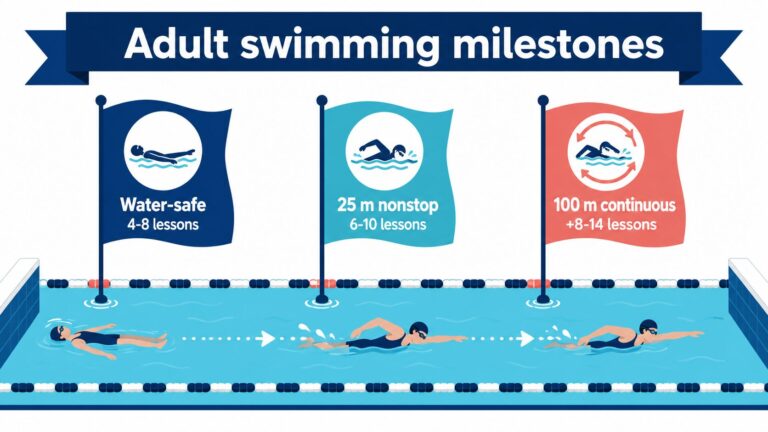
- Swim 100 m continuously in the pool.
- Exit the water without a ladder.
That list roughly mirrors what diploma C tests, minus the ceremony. If you can do all five, you’re functionally water-safe for Dutch conditions. If you can’t, that’s your training plan.
What to do instead: adult swimming lessons in Amsterdam
Where you start depends on where you are today:
| Your current level | Start here | Focus |
|---|---|---|
| Can’t swim, or afraid of water | Beginner lessons or aquaphobia lessons | Face in the water, exhale, float, recover |
| Can swim 25 to 50 m | Intermediate lessons | Technique, breathing control, safe entries and exits |
| Comfortable with 100 m+ | Advanced lessons | Endurance, open-water skills, reading currents and cold shock |
We run small groups in Amsterdam-Noord, and most complete beginners reach that 100 m checklist level within a season. If you’re wondering how long it takes, we’ve written a full breakdown in how many swimming lessons adults need.

When a Dutch swimming diploma makes sense anyway
For most readers the diploma is a nice to have. For a few it’s more than that. If your career plan includes Dutch emergency services, aviation, or professional work on the water, get the diploma; employers there ask for it by name and it never expires. Book an adult diploma track and train for the C level directly.
For everyone else, treat diploma C as a syllabus. It’s an excellent description of what a water-safe adult can do. You can train to that standard without ever sitting the exam.
FAQ
Do expats need a Dutch swimming diploma to use public pools? No. Adults are admitted to public pools in the Netherlands based on visible swimming ability. Diploma rules with armbands and shallow-end restrictions apply to children, as local pool policy rather than national law.
Is the Dutch swimming diploma required by law? No. There is no legal requirement for adults or children to hold a swimming diploma in the Netherlands. In April 2025 the Dutch government confirmed that mandatory school swimming will not be reintroduced.
Can adults get a Zwem-ABC diploma in the Netherlands? Yes. Adults can train for and take the official A, B and C diploma exams through swim schools that run adult programs. The diplomas are internationally recognized and never expire.
What is the difference between swimming diploma A, B and C? Diploma A proves basic self-rescue in a pool (50 m continuous swim). Diploma B adds endurance and skills for pools with slides and waves (75 m). Diploma C proves safety in open water without current (100 m, swum partly in full clothing) and equals the Dutch national water safety standard.
Is a foreign swimming certificate valid in the Netherlands? There is nothing to validate it against, because no Dutch law requires a certificate. For jobs or clubs that ask for B or C level, a foreign certificate is usually assessed case by case; some employers ask for the Dutch diploma specifically.
Whether you ever frame a diploma or not, the water here doesn’t check paperwork; train until you trust yourself in it.
Written by
Vlad Paturca
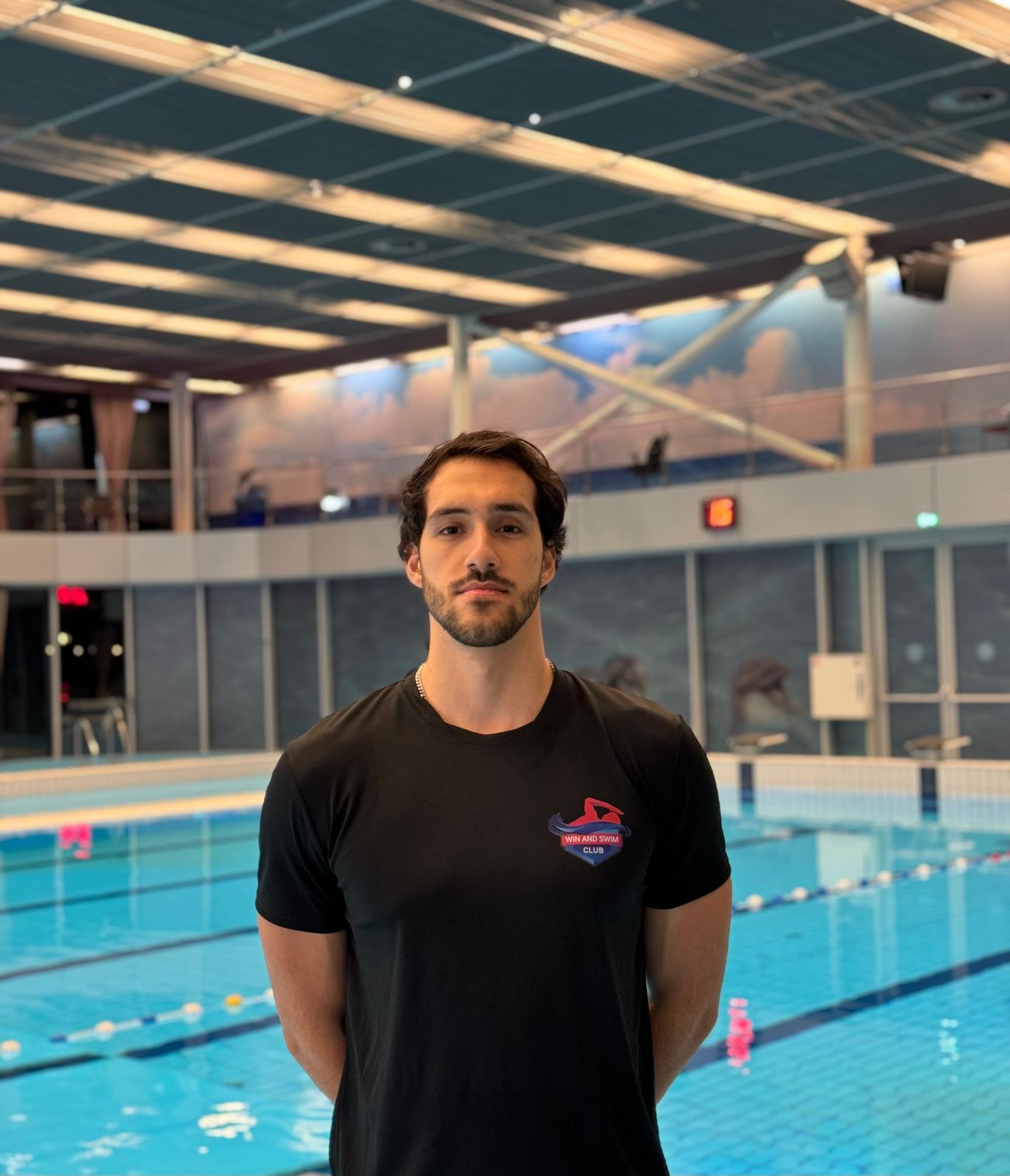
KNZB-certified swim coach, former Romanian national and international freestyle medalist, and founder of Win and Swim Amsterdam. Passionate about adult learners and evidence-based technique. With a bachelor degree in swimming and a first aid course, swimming is my element.
More about Win and Swim →