How Many Swimming Lessons Do Adults Need?

Everyone wants a number. “Just tell me how many lessons and I’ll plan my life.” The problem is that a single magic number is a trap: it makes you judge yourself against someone else’s timeline, and that’s how adults quit. Here’s the better approach: pick a clear milestone, then work backwards from the skills it requires.
So, how many swimming lessons do adults need? If your milestone is swimming 25 metres nonstop in a pool, many adults can reach that in roughly 6 to 10 coached sessions with consistent attendance (plus a bit of practice time if possible). If you already can swim 25 m nonstop and want to level up to 100 metres continuous, the next jump is often 6–12 focused sessions, depending on frequency and effort.
One more thing that changes the whole timeline: in our experience coaching adults, progress usually isn’t blocked by “fitness.” It’s blocked by breathing, balance, and tension.
How many swimming lessons do adults need? Start with these benchmarks
Before we talk lesson counts, get honest about what “learn to swim” means for you. There are three common adult goals:
- Water-safe adult: you can float, breathe calmly, and move to the wall without panic.
- Pool-competent adult: you can swim 25 m–100 m in control, rest, and repeat.
- Fitness swimmer: you can swim multiple lengths with efficient front crawl (freestyle) and predictable breathing.
A “session” also needs to mean something. On our end, a standard coached lesson is 60 minutes. That matters because “10 lessons” isn’t the same thing everywhere. (If you want an overview of how we structure adult levels, it’s laid out on our adult lessons overview page.)
Here are two milestones that give adults the clearest planning anchor:
- 25 m nonstop: ~6–10 coached sessions for many beginners, with consistent attendance.
- 100 m continuous (if you’re already at 25 m): often ~6–12 focused sessions.
If you’re starting from scratch, the 25 m milestone is usually the first real “I can do this” moment. If you already “survive” but you’re sloppy or anxious, 25 m might be the reset point where you rebuild technique instead of muscling through.
How many swimming lessons do adults need to swim 25 meters?
Swimming 25 m nonstop is less about bravery and more about not wasting oxygen.
In beginner adult lessons, we usually see the same pattern in the first minutes: people hold their breath, lift their head to “check,” their hips sink, and suddenly the pool feels twice as long. Fix the breathing and body position, and distance happens almost by accident.
What actually gets built across those first coached sessions (in a sensible order):
- Breathing control: exhale into the water first, then inhale quickly when you turn or lift.
- Floating and balance: front float and back float without kicking like you’re escaping a shark.
- Propulsion basics: a relaxed kick, then simple stroke timing.
- A first “reliable stroke”: for many adults that’s front crawl (freestyle); for others it’s breaststroke.
If fear is the main blocker, don’t chase metres. Start with calm breathing, floating, and gradual exposure first (here’s what that progression looks like on our aquaphobia swimming lessons page).
If you’re curious what a structured beginner progression looks like, here’s the outline of skills we teach in beginner adult classes: water comfort, floating, breathing, and basic breaststroke, front crawl, and backstroke technique. (That’s the foundation, not the finish line.)
At Win and Swim in Amsterdam-Noord, the adults who hit 25 m faster usually do one boring thing well: they practise breathing between lessons instead of treating lessons like a weekly performance.
How often should adults take swimming lessons?
Frequency is the quiet multiplier.
- 1× per week works if you’re consistent and you don’t “reset” emotionally every session.
- 2× per week is the sweet spot for many adults because you spend less time re-learning last week’s comfort and more time building new skill.
If you can add even 1 short practice swim between lessons, it often does more than adding another coached session, because it turns swimming into a normal thing your body expects.
There’s also a learning-science reason coaches care about spacing: a meta-analysis on “distributed practice” (spreading practice out instead of cramming it) reviewed 317 experiments and found spaced practice reliably improved later performance compared with massed practice (Cepeda et al., 2006). You can read the paper summary here: Distributed practice meta-analysis (Cepeda et al., 2006)
A simple, realistic schedule for adults with jobs and lives:
- Best: 2 lessons/week + 1 easy solo swim (20–30 minutes).
- Solid: 1 lesson/week + 1 easy solo swim.
- Slow but steady: 1 lesson/week only (still works, just expect more “warm-up weeks”).
How long does it take to learn to swim as an adult?
Convert sessions into calendar time and the fog clears.
If your target is 25 m nonstop and you’re aiming at the 6-10 coached-session range:
- At 1 lesson/week: about 6-10 weeks.
- At 2 lessons/week: about 3-5 weeks.
If your target is 100 m continuous and you already can do 25 m nonstop, and you’re aiming at the 8-14 session range:
- At 1 lesson/week: about 8-14 weeks.
- At 2 lessons/week: about 4-7 weeks.
Notice what’s missing: “talent.” Adult timelines usually hinge on two things you can control:
- Consistency (sessions close enough together that the fear doesn’t regrow), and
- Homework (even five minutes of breath and float work changes everything).
Learn to swim as an adult in Amsterdam: don’t ignore the water reality
Amsterdam is a water city, which is fun… until you realise you’ve been avoiding it.
If you want one blunt reason to learn: drowning is not a rare, abstract thing. Statistics Netherlands (CBS) reported 146 fatalities due to accidental drowning in 2024 (provisional), 107 residents and 39 non-residents. Even if your personal goal is “just enjoy holiday pools,” water confidence is a safety skill in the Netherlands.
Practical coaching advice for Amsterdam adults:
- Don’t “graduate” from pool to open water too early. Open water punishes shaky breathing and panic.
- Make 25 m boring before you make it hard. If 25 m feels dramatic, you’re not ready for distance or deep-water stress.
- Learn a calm recovery skill. Back float is underrated. It’s the adult “reset button.”
And yes, technique matters. A smoother front crawl isn’t just faster; it’s more predictable under stress. When you stop fighting the water, you stop burning oxygen.
FAQ
How many swimming lessons do adults need to learn to swim?
Many adults can reach a clear first milestone, swimming 25 m nonstop in a pool, in roughly 6–10 coached sessions with consistent attendance. “Learn to swim” can mean more than 25 m, so the total number of sessions depends on whether you also want 100 m continuous, multiple strokes, or deep-water comfort.
How many lessons does it take to swim 25 m nonstop?
For many beginners, 25 m nonstop is achievable in roughly 6 to 10 coached sessions if attendance is consistent, plus a little practice time if possible. If fear, breath-holding, or panic shows up, expect the same distance to take longer because the first job becomes comfort.
How many lessons does it take to swim 100 m continuously?
If you already can swim 25 m nonstop with basic strokes, many swimmers reach 100 m continuous within about 8-14 focused sessions, depending on frequency and effort. If you cannot yet do 25 m nonstop, start with the 25 m milestone first.
How often should I take swimming lessons as an adult?
One lesson per week can work, but two lessons per week usually speeds progress because you spend less time “restarting” each session. Adding one short practice swim between lessons often accelerates learning even more.
Can I learn to swim as an adult if I’m scared of water?
Yes. Adults usually need a calmer progression: breathing control, floating, and gradual exposure before stroke technique. If fear is the main blocker, start with step-by-step confidence work (not distance goals) until breathing stays calm.
One soft next step if you want structure: start with the step-by-step fundamentals on our beginner swimming lessons page.
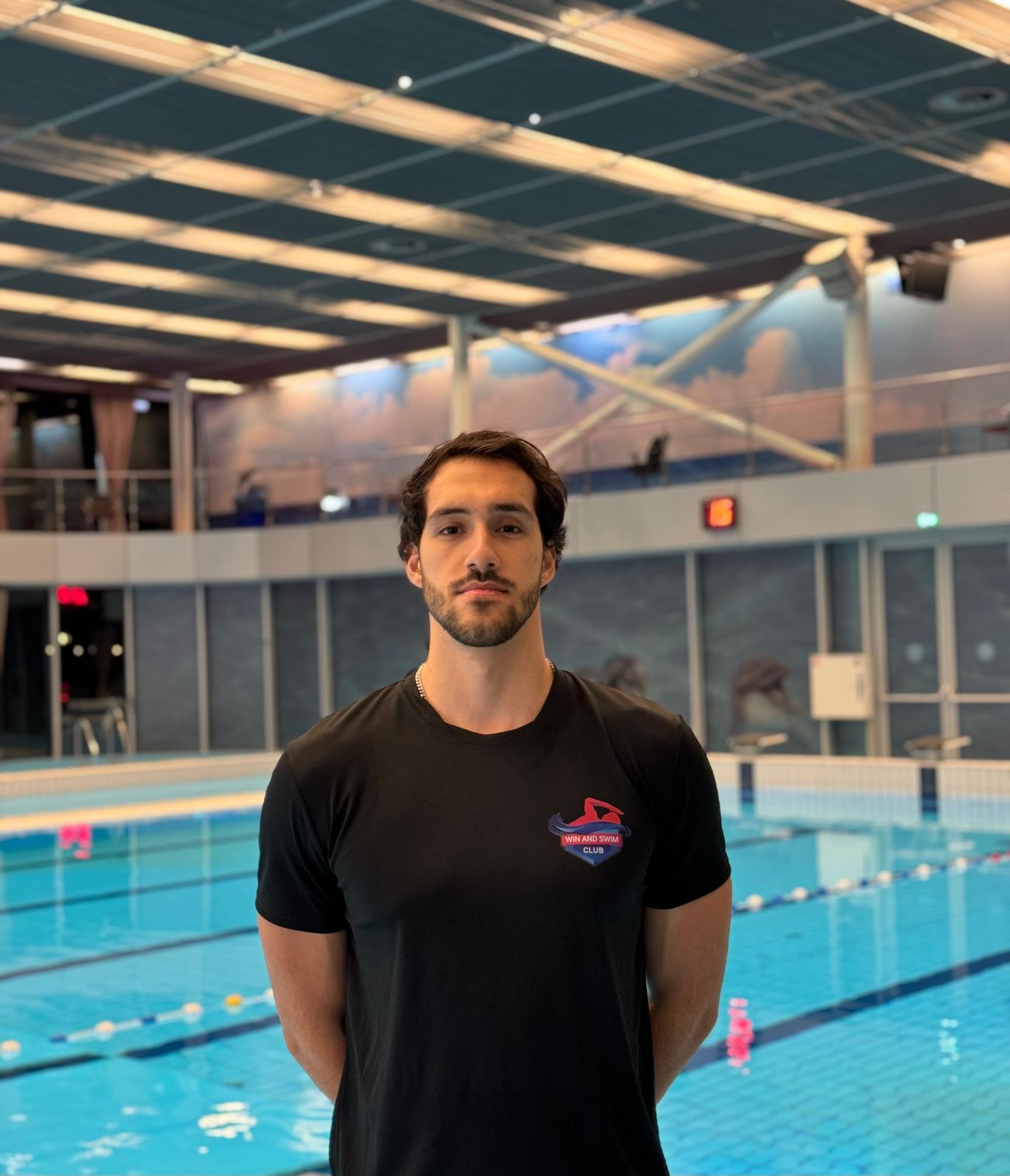
KNZB‑certified swim coach, former Romanian national and international freestyle medalist, and founder of Win and Swim Amsterdam. Passionate about adult‑learners and evidence‑based technique. With bachelor degree in swimming and first aid course, swimming is my element.